
Anduril's $61B valuation: what doubling in a year signals for the drone-autonomy industry
Anduril's $5B raise at a $61B valuation (May 2026) doubled its worth in a year — a read on where drone-autonomy capital and scale are heading.
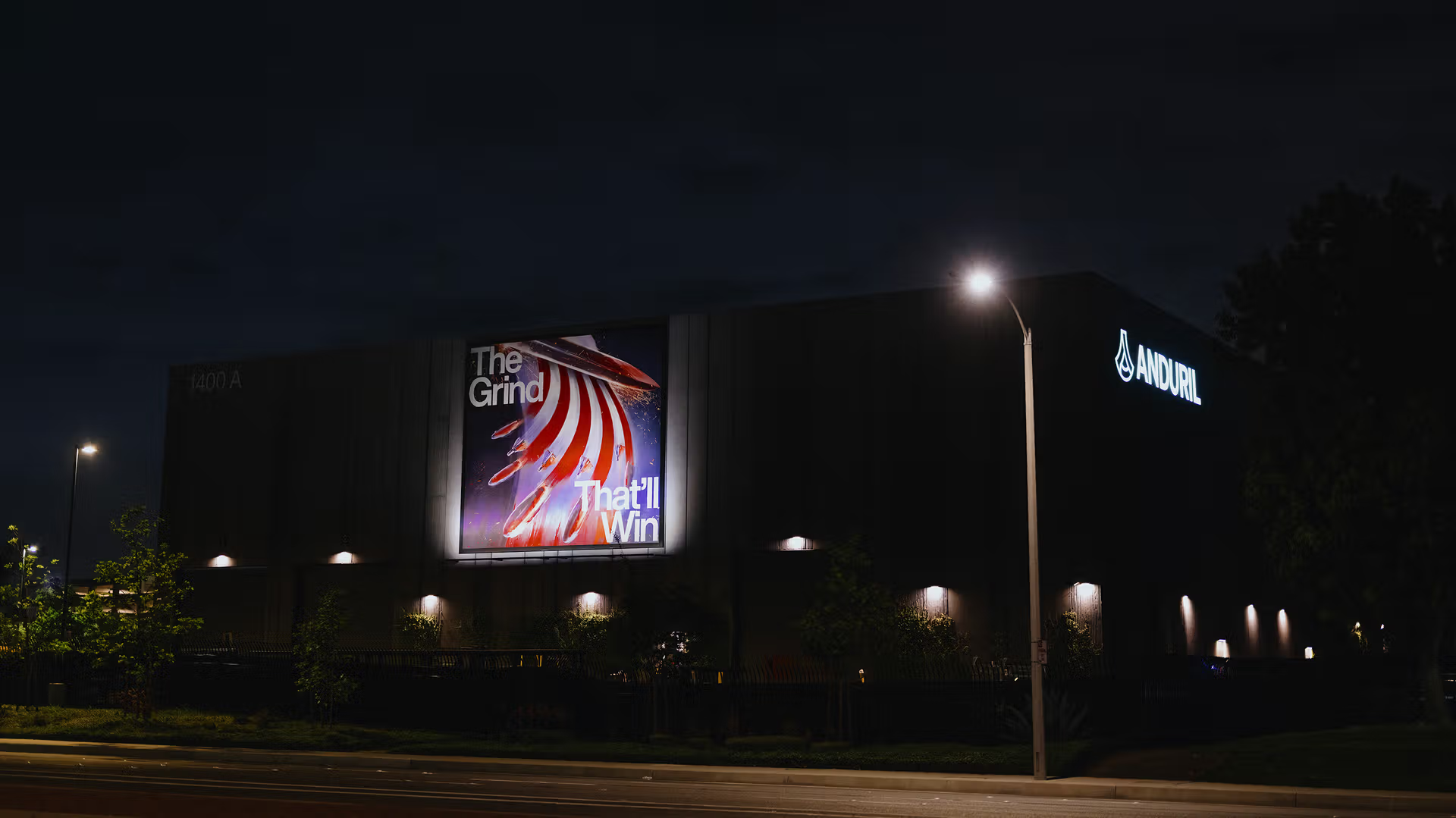
In May 2026 Anduril raised $5 billion at a $61 billion valuation, led by Thrive Capital and Andreessen Horowitz — roughly double the $30.5 billion it commanded in June 2025 (a $2.5 billion Series G led by Founders Fund that was reportedly more than 8x oversubscribed). Strip away the headline figure and the more useful question is what investors are actually buying. The answer is an uncrewed-systems portfolio — the Fury collaborative combat aircraft, the Ghost-X ISR drone, the Bolt-M loitering munition, and the Roadrunner-M counter-UAS interceptor — bound together by the Lattice autonomy software, and increasingly by the factories (Arsenal-1) built to produce them at volume.
Technical Breakdown
- Series H: $5B raised at a $61B valuation (May 2026); led by Thrive Capital and Andreessen Horowitz; Anduril's largest round to date
- Prior round: Series G — $2.5B at $30.5B (June 2025), led by Founders Fund, ~8x oversubscribed
- Pace: valuation roughly doubled in ~12 months
- What it funds: the drone/autonomy portfolio (Fury CCA, Ghost-X, Bolt-M, counter-UAS) plus hyperscale manufacturing (Arsenal-1)
Industry Impact
The markup is best read as a signal about where value in the drone industry is migrating:
- Capital is rewarding mass, not just design. The valuation tracks Anduril's pivot from prototypes to production — Arsenal-1 coming online, Bolt-M scaling from ~100 toward ~175 units a month, multi-thousand-unit frameworks. The premium is on the ability to manufacture autonomy at scale, not merely demonstrate it.
- Private money is reshaping the defense-drone base. A venture-funded firm self-funding its own factories compresses timelines and pressures incumbent primes, but it also concentrates the uncrewed-systems supply chain around a few heavily capitalized players.
- It validates the autonomy-software thesis. Investors are paying for Lattice as the connective layer across drones and counter-drone systems — the platform, not any single airframe.
- Risks worth watching. Valuations doubling yearly invite an eventual correction; heavy reliance on US programs is a concentration risk; and a venture-scale weapons maker raises governance questions a traditional contractor would not.
For the wider drone industry, the takeaway is that money — and therefore talent and manufacturing capacity — is consolidating around autonomous systems, which will shape pricing, hiring and competition well beyond Anduril itself.