
Drone Incursions at Wildfires Surge as Aircraft Face More Groundings
Unauthorized drone incursions near wildfires hit 74 in 2026, grounding firefighting aircraft 78% of the time as the FAA's DETER program tightens enfor
Main Story
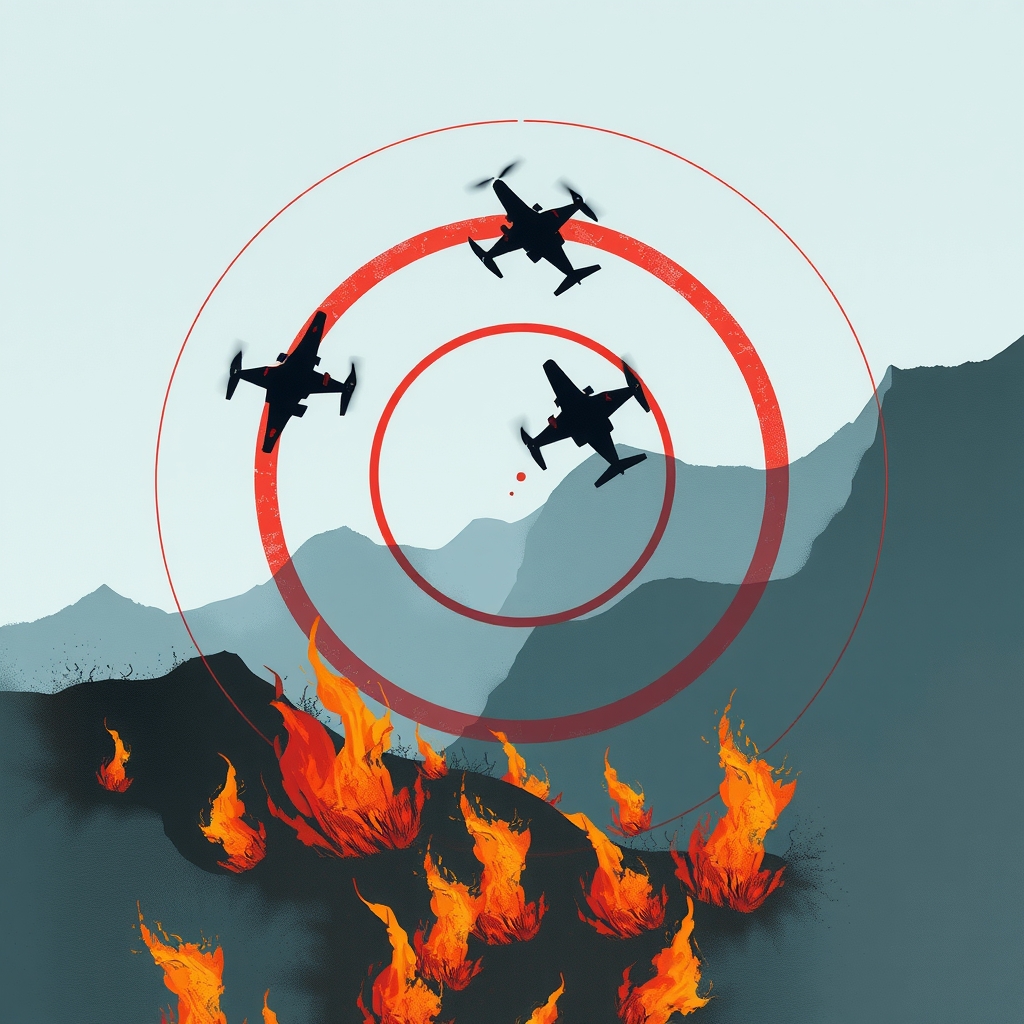
The 2026 wildfire season in the western United States has produced a troubling parallel surge: alongside the fires themselves, unauthorized drone flights into restricted airspace over active incidents have reached their highest non-Los-Angeles-fire-spike level on record.
According to the U.S. Wildland Fire Service (WFS) — an agency of the Department of the Interior — 74 drone incursions had been logged near wildfire operations as of September 1, 2026. That compares with 53 incursions across all of 2025 and 32 in 2024, marking a steep multi-year acceleration. The WFS defines an incursion as "a non-participating UAS operating over or near an incident that intrudes into an area with a temporary flight restriction (TFR) or interferes with incident/mission operations."
The operational consequence is direct and measurable. Data from the interagency Aviation Safety Communiqué — which aggregates incursion records across the Interior Department, the USDA Forest Service, and participating state jurisdictions — shows that such incursions resulted in firefighting aircraft being diverted 78% of the time. Every grounding removes retardant drops, aerial reconnaissance, and crew transport from an active suppression effort, potentially allowing fires to grow.
Washington state is the epicentre of the 2026 problem. Of the 74 total incursions recorded through September 1, 45 occurred in Washington, concentrated around the Spokane region where several large fires burned through densely populated areas. California reported the next highest tally, at seven incursions. The Spokane situation escalated to the point where the FBI deployed a Counter-UAS Task Force with purpose-built radio-frequency detection equipment over the affected TFR, logging 39 unauthorized drones in a two-day window and halting aerial firefighting during that period.
A specific illustrative incident occurred on June 29 near Beaver, Utah, when a DJI Phantom 4 flew into the restricted airspace over the Face Canyon fire, shutting down aerial firefighting operations for approximately one hour.
The problem is not new, but its scale is escalating. In 2025, the Interior Department recorded 53 unauthorized drone incursions during wildfire operations, of which 44 directly interfered with or threatened aerial firefighting assets. A January 2025 collision over the Palisades Fire in California — in which an unauthorized drone struck a Canadair CL-415 "Super Scooper" amphibious tanker, punching a hole in the aircraft's wing and grounding it — remains the most cited physical consequence of these incursions. The drone operator subsequently agreed to plead guilty to unsafe operation of an unmanned aircraft and faced restitution and community service requirements.
Separate data shows the broader national footprint: in September 2026, two unauthorized drones forced the grounding of aerial assets battling a wildfire in Garland County, Arkansas — extending the pattern well beyond the traditionally wildfire-prone West.
Detection Is Hardening — But Gaps Remain
For years, TFR enforcement near wildfires depended largely on ground observers physically spotting a drone and attempting to trace it back to its operator. That model is shifting. The FBI Counter-UAS deployment over Spokane used detection systems capable of identifying both the drone's position and the location of its ground controller via radio-frequency signatures — a materially different enforcement posture.
The FAA has also introduced structural enforcement reform. On April 17, 2026, the agency published the Drone Expedited and Targeted Enforcement Response (DETER) Program, a fast-track settlement mechanism designed to accelerate case resolution for eligible first-time UAS violators. Under DETER, operators who accept a Violation Notice have 10 days to pay a reduced civil penalty, surrender their remote pilot certificate if applicable, and complete required corrective actions — in exchange for waiving all appeal rights. The FAA's January 2026 UAS Compliance and Enforcement Bulletin had already made legal enforcement action mandatory for operations that endanger the public or violate established airspace restrictions, closing the prior "education-first" compliance pathway for such cases.
Financially, the stakes are significant. The FAA holds authority to issue civil penalties of up to $75,000 per violation, and proposed penalties in wildfire-TFR cases have exceeded $36,000. Interfering with firefighting operations on public lands also constitutes a federal crime carrying a potential sentence of up to two years in prison.
Despite tightening enforcement, detection remains imperfect. The Forest Service's assistant director of aviation safety, Lyndsay Johnson, has noted that the actual number of intrusions is likely higher than recorded figures, constrained by visibility and the availability of detection equipment in remote terrain.
The interagency "If You Fly, We Can't" public education campaign — run jointly by federal and state wildland fire management agencies and the FAA — continues in parallel, but incident data through 2026 indicates it has not yet bent the incursion curve.
Technical Breakdown
Platform/UAS Class: Consumer and prosumer multirotor UAS; the confirmed Beaver, Utah incident involved a DJI Phantom 4 (sub-1.5 kg, hobby-class quadrotor). Most documented incursions involve small UAS (sUAS) under 25 kg per FAA Part 107 definitions.
Regulatory Class: All aircraft operating within an FAA-issued Temporary Flight Restriction (TFR) without specific authorization are in violation of 14 CFR § 91.137, regardless of platform type or operator certification status.
Detection Technology: The FBI Counter-UAS deployment over the Spokane Complex fires used purpose-built RF detection equipment capable of tracking both drone position and ground-controller location. Larger drones with active Remote ID transmitters can also be tracked via their Remote ID signal; smaller consumer drones are detectable via controller RF emissions.
Collision Precedent: The January 2025 Palisades Fire strike involved a consumer drone and a Canadair CL-415 Super Scooper (a large twin-turboprop amphibious air tanker), causing physical wing damage requiring grounding for repairs.
Airspace Overlap: Firefighting aircraft — including air tankers, Type 1 heavy-lift helicopters, and reconnaissance fixed-wing platforms — routinely operate at altitudes of a few hundred feet AGL, placing them in direct conflict with consumer UAS operational ceilings.
Authorized UAS Use: The Forest Service has sharply increased its own sanctioned drone deployments; from 2019 to 2025, authorized agency drone flights on active incidents increased by approximately 2,483%, used for fire mapping, hotspot detection, and crew tracking — making TFR airspace management even more complex.
Industry Impact
Manufacturers: The prevalence of consumer platforms (e.g., DJI Phantom series) in documented incursions reinforces ongoing regulatory and industry pressure on manufacturers to implement geofencing and Remote ID compliance. Any further legislative response to the 2026 surge could accelerate mandated geo-awareness standards for sub-250 g and small recreational UAS.
Operators (Commercial & Recreational): The FAA's DETER program materially changes the risk calculus for any operator flying near an active TFR. The 10-day settlement window, mandatory liability admission, and permanent waiver of appeal rights make violations far more consequential than under the prior compliance-action model. TFR violations in wildfire contexts do not qualify for DETER's reduced-penalty pathway and go directly to full enforcement.
Regulators: The FBI Counter-UAS deployment in Spokane represents a significant escalation in enforcement resourcing, moving detection from passive ground observation to active RF-based tracking. This model, if replicated across future fire seasons, requires sustained inter-agency coordination between the FAA, FBI, Forest Service, Interior Department, and state aviation authorities — a structurally complex and resource-intensive posture.
Integrators & Counter-UAS Vendors: The documented scale of the 2026 incursion surge — and the FBI's active deployment of counter-UAS detection systems — signals a growing operational and procurement opportunity for RF detection, drone identification, and airspace management system vendors operating in emergency-response contexts.
Investors: The widening gap between authorized drone utility in wildfire operations (2,483% growth in agency flights from 2019–2025) and the enforcement burden created by unauthorized incursions points to durable demand for both counter-UAS detection infrastructure and next-generation airspace deconfliction software at incident command level.