
Elistair Unveils Tethered Air Module for the Parrot ANAFI UKR, Stretching 38-Minute Battery Endurance to Hours
Elistair's new air module connects the Parrot ANAFI UKR to Safe-T 2 and Ligh-T 4 tether stations, enabling hours of continuous ISR flight.
Main Story
On 21 October 2026, Lyon-based Elistair announced a new dedicated air module that physically and electrically bridges the Parrot ANAFI UKR micro-UAV to the company's established family of ground tether stations. The announcement marks the first time the ANAFI UKR — a sub-kilogram tactical platform introduced at the 2025 Paris Air Show — has been qualified for continuous-power tethered operations.
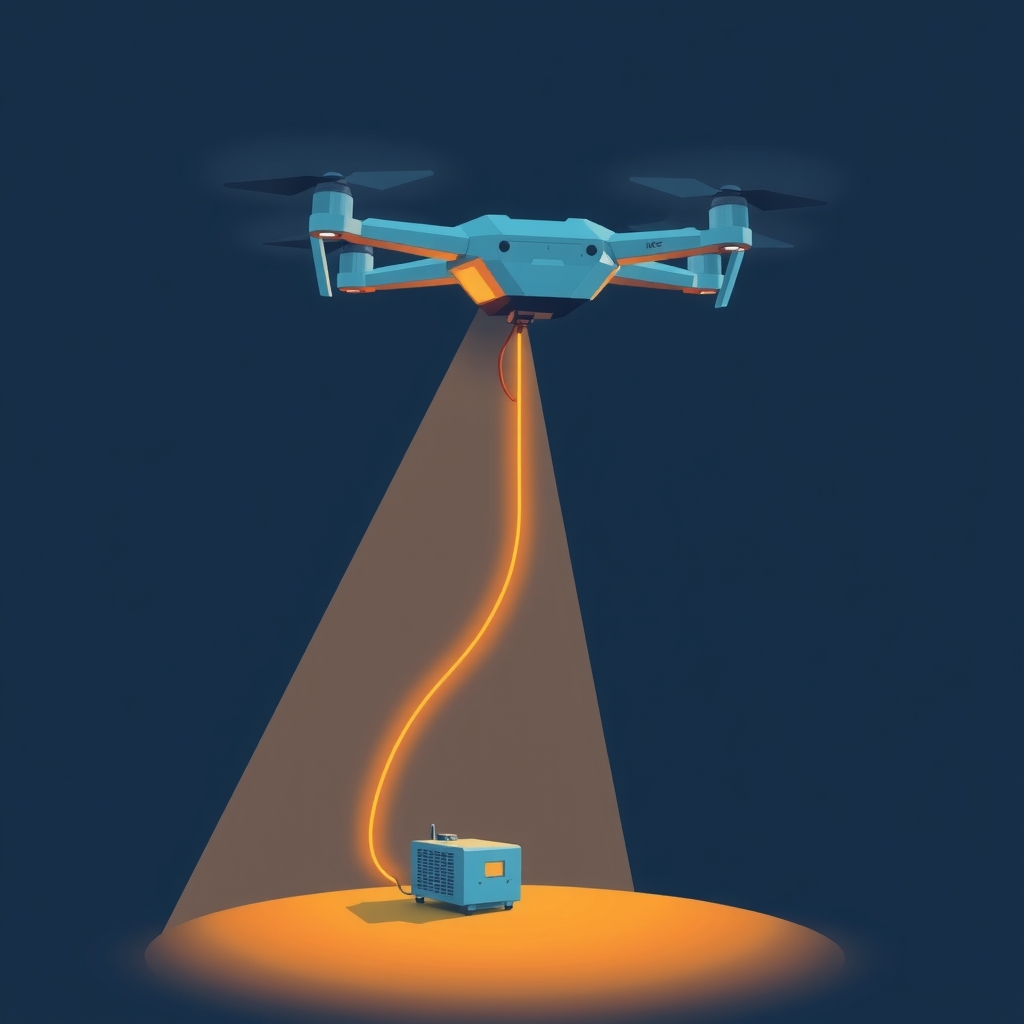
The core engineering premise is straightforward: the ANAFI UKR carries a standard smart battery rated for roughly 38 minutes of autonomous flight. By substituting or supplementing that onboard energy store with a micro-tether that pipes power from a ground station, the system trades finite battery capacity for the near-unlimited energy of a mains or generator supply. The result is persistent aerial overwatch measured in hours rather than tens of minutes — a meaningful operational shift for surveillance missions where battery rotation requires additional personnel, logistics, and mission interruption.
Elistair designed the air module to work with both stations in its current portfolio: the Safe-T 2 and the Ligh-T 4. The two products occupy different operational niches. The Safe-T 2 is an IP54-rated, vehicle- or fixed-installation-friendly station that delivers up to 2,500 W of peak power through a 110-metre micro-tether and is certified by the French Civil Aviation Authority. The Ligh-T 4 is a more portable, IP51-rated compact station built around a lighter 70-metre micro-tether with up to 1,800 W peak power, optimised for rapid dismounted deployment. Both stations transmit power and high-speed data over the same tether cable, keeping the drone's sensor feeds secure and unjammable by radio-frequency interference.
Deployment speed is a recurring theme in Elistair's positioning of the system. The company states the configuration — from unpacking to airborne — takes under two minutes in the field, matching the ANAFI UKR's own quoted readiness time from Parrot's specification sheets.
Elistair's tethered stations are already a mature product line. The company reports over 2,000 ground stations currently operational across more than 70 countries. The ANAFI UKR now joins a catalogue of more than 50 airframes that have been formally qualified on an Elistair tether, with the Air Module family covering 6 S, 8 S, and 12 S power architectures.
Parrot framed the integration as extending the ANAFI UKR's operational capabilities while preserving its portability, ease of deployment, and secure data architecture. The ANAFI UKR GOV variant is Blue UAS-approved and NSN-compliant, and has been deployed by several European, North American, and NATO-allied forces since mid-2024.
Target mission sets for the tethered configuration include force protection, perimeter and border surveillance, event security, and emergency response support — roles that share a common requirement for continuous uninterrupted aerial presence rather than intermittent sorties.
Technical Breakdown
Platform / UAV class: Parrot ANAFI UKR — tactical micro-UAV / quadcopter
Weight: 959 g (airframe); maximum take-off mass 1,450 g
Payload / sensors: Dual EO/IR stabilised gimbal comprising a 35× zoom RGB camera and a FLIR Boson® thermal imager; optical identification of human-sized targets to 2.2 km (EO) and 173 m (IR) from 121 m AGL
Propulsion: Electric quadrotor; maximum airspeed 17 m/s; propeller speed 8,500 rpm
Standard endurance: Up to 38 minutes on internal battery (up to 50 minutes with extended XLR battery); tethered configuration extends this to continuous multi-hour operation
Tether — Safe-T 2: 110 m micro-tether; up to 2,500 W peak power; IP54-rated; 100 m operational altitude; French civil aviation authority-approved
Tether — Ligh-T 4: 70 m micro-tether; up to 1,800 W peak power; IP51-rated; 70 m operational altitude; air module weight 500 g
Air module deployment time: Under 2 minutes (system-level); convertible from tethered to free-flight within seconds
Autonomy level: Supports optical navigation (Visual-Inertial Odometry) for GNSS-denied environments; AI-based object tracking and obstacle avoidance; frequency-hopping MARS military radio with LoRa fallback; NIST FIPS 140-2 Level 3 and EAL5+ cybersecurity certification
Comms: Encrypted dual-radio (Wi-Fi / 5G), MARS frequency-hopping military radio, LoRa backup; high-speed data over tether (fibre option available on Safe-T 2)
Environmental rating: IP53 (airframe); operating temperature −36 °C to +50 °C; wind resistance up to 15 m/s
Industry Impact
Manufacturers: The integration demonstrates a product-extension pathway available to micro-UAV makers whose platforms are constrained by battery energy density. By qualifying with a third-party tether ecosystem rather than developing a proprietary ground station, Parrot gains persistent-overwatch capability without the engineering overhead of a dedicated power mooring system. For Elistair, adding the ANAFI UKR expands its qualified airframe catalogue beyond 50 platforms and reinforces its position as a hardware-agnostic tether infrastructure provider.
Operators: Defence and public safety units already operating the ANAFI UKR can upgrade to persistent overwatch with a single additional module rather than procuring an entirely different platform class. The sub-two-minute deployment claim, if borne out in field conditions, is significant for dismounted small-unit use where setup time directly affects tactical exposure.
Regulators: The Safe-T 2's existing French civil aviation authority certification establishes a regulatory precedent for tethered micro-UAV operations at altitudes up to 100 m. Operators in other jurisdictions will need to verify local tethered-drone exemptions, but an existing approval from a major European civil aviation body eases that path.
Investors: Elistair's reported deployment footprint — over 2,000 stations across 70-plus countries — signals proven commercial scale. The ANAFI UKR integration adds a Blue UAS-approved, NATO-qualified platform to the compatible airframe list, which could open procurement pathways in North American defence programmes that require Blue UAS compliance throughout the system stack.
Integrators: The pairing is presented as a fully sovereign European stack: Parrot (France) drone, Elistair (France) ground station. For programme offices prioritising supply-chain sovereignty, this all-European provenance reduces the complexity of foreign-military-sale approvals and export licensing that can affect mixed-origin systems.