
FBI Seized More Than 700 Drones Over World Cup Venues — And the Counter-UAS Technology Stack That Made It Possible
FBI seized 700+ drones at FIFA World Cup 2026 venues. A deep dive into the C-UAS tech stack, TFR framework, and new SAFER SKIES Act rules.
Main Story
When the 2026 FIFA World Cup opened on June 11 across 11 U.S. host cities, federal agencies activated what one senior FBI official described as "the most comprehensive airspace security and drone mitigation effort in U.S. history." By July 15 — with the final still days away — the bureau had detected nearly 1,600 illegal drone incursions and seized more than 700 aircraft, a tally that had doubled in under two weeks as the tournament progressed toward its conclusion at MetLife Stadium.
The scale of non-compliance was striking. Miami led all cities with 99 seized drones, followed by Atlanta at 77 and Dallas at 63 — figures drawn from the FBI's own public release. Confiscations were recorded in every one of the 11 host cities, confirming that the compliance problem was not concentrated in a single market but systemic across the recreational pilot community nationwide.
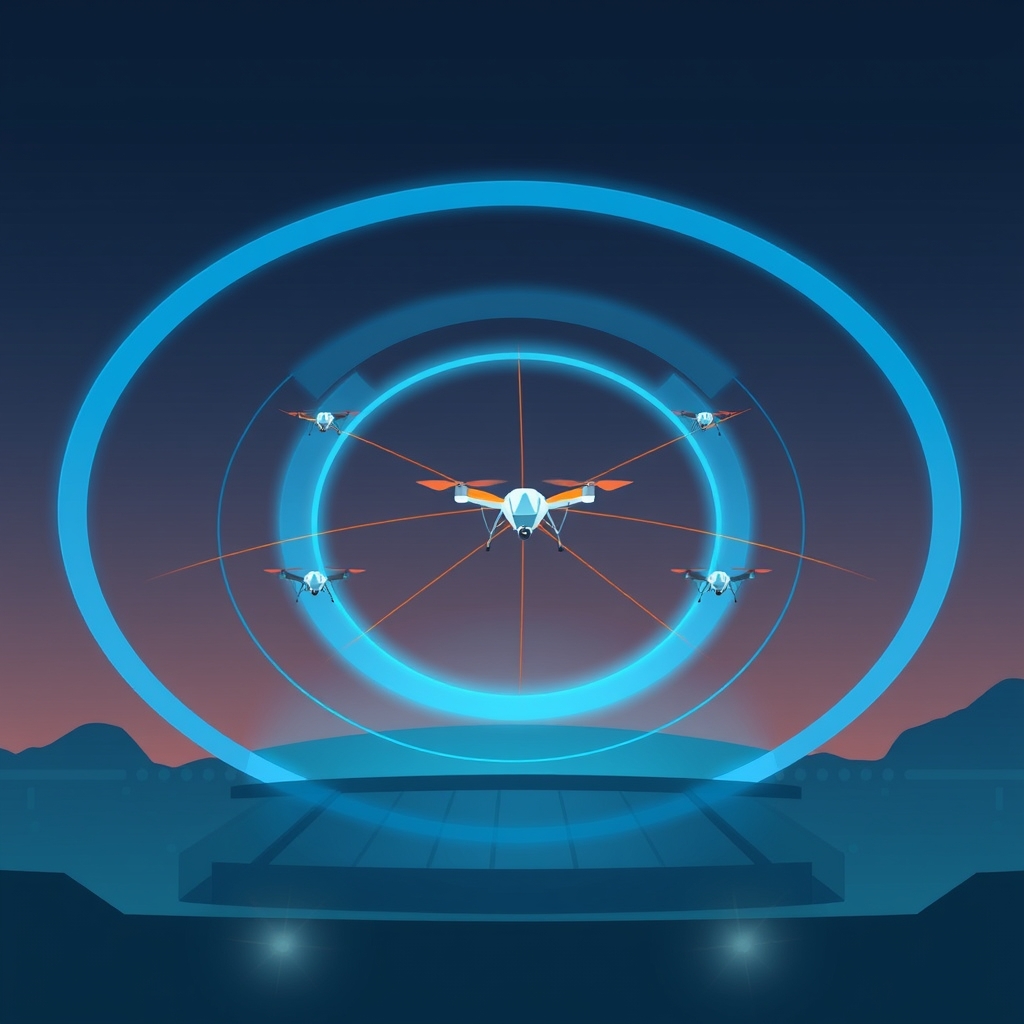
The legal framework underpinning every seizure was a network of Temporary Flight Restrictions (TFRs) established by the FAA in coordination with the Departments of Homeland Security and Justice. On match days, all aircraft operations — crewed or uncrewed — were prohibited within a 3-nautical-mile radius and up to 3,000 feet above ground level around stadiums. Fan-festival sites and team base camps attracted a tighter inner ring: a 1-nautical-mile radius up to 1,000 feet AGL. Federal law enforcement was explicitly authorised to deploy specialised mitigation tools against any aircraft entering those corridors, preserving evidence for enforcement action. Violations carried civil fines of up to $75,000, criminal fines up to $100,000, up to a year in federal prison, and confiscation of the drone.
The FBI also stood up a dedicated counter-drone training school ahead of the tournament, and officers from all 11 host cities underwent specialised instruction covering drone identification, detection equipment, and coordinated response procedures. That capacity-building effort proved directly relevant mid-tournament: on July 1, an Interim Final Rule co-published by DOJ and DHS under the SAFER SKIES Act — enacted as part of the FY2026 National Defense Authorization Act — took effect, formally expanding C-UAS operational authority to state, local, tribal, and territorial (SLTT) law enforcement agencies for the first time. The rule introduced a two-tier certification structure: Tier 1 covers detection and warning operations; Tier 2 covers active mitigation, requiring in-person training at the National Counter-UAS Training Center.
On the hardware side, federal procurement assembled a multi-layer technology stack. The Department of Homeland Security selected Fortem Technologies as the sole kinetic solution, deploying its net-equipped DroneHunter® interceptors — autonomous aircraft that physically capture rogue drones without creating debris or endangering crowds below. In parallel, Ondas subsidiary Sentrycs was contracted across most match venues to provide its Cyber-over-RF (CoRF) detection and mitigation capability. Officials separately confirmed that more than 300 drones were mitigated without the use of force — consistent with the non-kinetic profile of the CoRF approach.
The combined federal investment in C-UAS hardware for the tournament ran into the hundreds of millions of dollars. In January, DHS announced $115 million in counter-drone investments alongside the creation of a new Program Executive Office for UAS and Counter-UAS. A separate $250 million FEMA grant was allocated to the 11 U.S. host cities specifically for C-UAS and public safety technology.
Technical Breakdown
Airspace Restriction Architecture
- Stadium TFR: 3 nautical miles radius, surface to 3,000 ft AGL, active on match days
- Fan-festival / base-camp TFR: 1 nautical mile radius, surface to 1,000 ft AGL
- Coverage: All 11 U.S. host cities; team hotels, training facilities, and fan zones also covered
- Publication mechanism: FDC NOTAMs, typically 3–5 days prior to each event; also accessible via tfr.faa.gov and the FAA B4UFLY app
Kinetic Layer — Fortem DroneHunter®
- Autonomous interceptor drone equipped with net-capture payload
- Designed to physically intercept and remove rogue UAS without creating debris fields
- Part of Fortem's AI-powered SkyDome® Family of Systems, integrating TrueView™ radar sensors and command-and-control software
- Selected by DHS as the only kinetic C-UAS solution in the World Cup procurement
Electronic Layer — Sentrycs Cyber-over-RF (CoRF)
- Passive RF-based detection, tracking, and identification of unauthorised UAS
- Mitigation mode: the system communicates with the target drone over its RF control link, disconnects it from the original operator, and guides it to a controlled landing at a pre-designated area
- No jamming, no kinetic impact — preserves spectrum integrity for cellular networks and broadcast infrastructure at crowded venues
- Deployed across most U.S. match venues, fan zones, and event locations under contracts with federal, state, and local agencies
- Certified across 25+ countries; also deployed with German State Police and multiple European military bases
Operational Scope
- Approximately 1,600 drone incursions detected across 11 cities between June 11 and July 15
- 700+ aircraft physically seized; 300+ mitigated without force
- Personnel: FBI counter-UAS protection teams, federal air marshals (TSA), and — from July 1 — SLTT-certified officers
Industry Impact
For C-UAS Manufacturers: The World Cup produced the largest real-world, multi-city C-UAS operational dataset ever assembled in a civilian context. Performance data from Sentrycs' CoRF deployments and Fortem's DroneHunter® intercepts across 11 simultaneous venues will inform product roadmaps, procurement specifications, and investor narratives ahead of the 2028 Los Angeles Olympics — an event already cited by the FBI as the next major planning horizon.
For Regulators: The SAFER SKIES Act IFR, effective July 1, is a structural inflection point. The two-tier certification framework — Tier 1 for detection/warning (online), Tier 2 for active mitigation (in-person at the National Counter-UAS Training Center) — creates a replicable, scalable model for SLTT agency deployment at future mass-attendance events. With public comments accepted through September 4, 2026, the rule is still being shaped, and counter-drone technology vendors have an active window to influence the Authorized Technologies List criteria.
For Operators and Integrators: The detection-to-seizure ratio (roughly 700+ seized from ~1,600 detected) implies a significant gap between detections and physical recoveries — and a corresponding opportunity for integrators who can improve operator-identification and ground-interception workflows. The multi-city, multi-agency coordination model also surfaces demand for unified C2 software that can federate sensor feeds from kinetic and electronic layers across geographically distributed venues.
For Recreational Drone Pilots: More than 700 aircraft confiscated with the tournament's enforcement posture telegraphed months in advance — through FAA advisories, FBI field-office warnings, and a coordinated public messaging campaign — is a data point about TFR awareness, not just enforcement intensity. The post-tournament after-action numbers are likely to anchor the next revision of FAA pilot education requirements for airspace-awareness apps and registration acknowledgements.
For Investors: The World Cup procurement demonstrated that multi-million-dollar, multi-vendor C-UAS contracts at civilian events are now a repeatable procurement category, not a one-off. DHS has a standing Program Executive Office for UAS/C-UAS, and the FEMA grant model used for the World Cup host cities provides a funding template for future major events. Companies with proven, regulation-compliant, non-jamming mitigation technology — capable of operating in RF-dense civilian environments — are positioned to capture a disproportionate share of that pipeline.