
Flytrex Adds Rooftop Drone Docks and AI Fleet Positioning in Dallas
Flytrex's new rooftop docks and AI positioning pre-stage drones at DFW restaurants before orders arrive, cutting costs 60% and delivery times by half.
Main Story
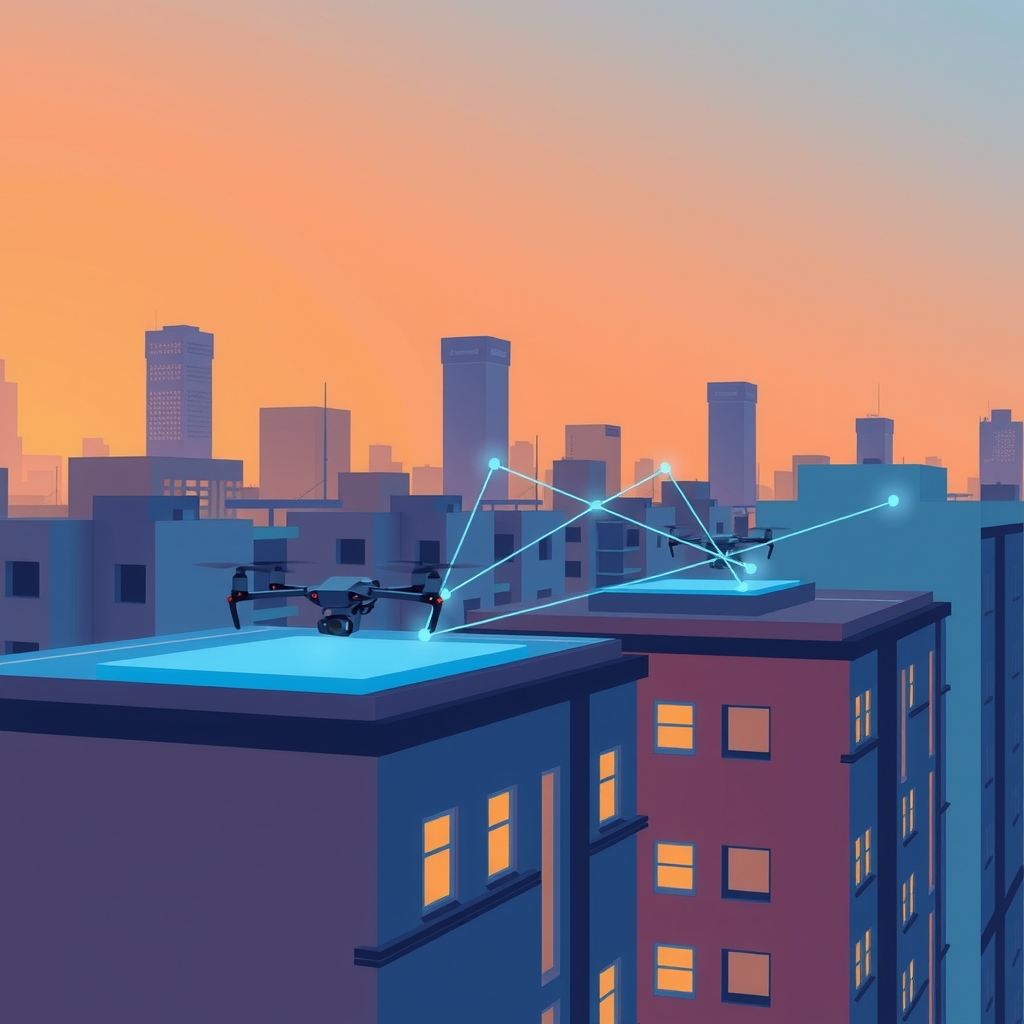
Drone delivery operator Flytrex has announced a two-part infrastructure upgrade for its Dallas-Fort Worth network that fundamentally changes where — and when — its aircraft sit between deliveries. Rather than dispatching drones from a centralised hub only after an order is confirmed, the new system parks aircraft directly on restaurant rooftops in anticipation of demand.
The problem Flytrex is solving is well-documented inside the industry. Traditionally, drone delivery companies have dispatched drones from a centralised location once an order is ready for pickup, which adds time and cost to every trip. By the time an aircraft reaches the restaurant, food may already be waiting — or cooling. Flytrex's new approach collapses that inbound leg entirely.
The system rests on two interlocking technologies. First, a physical Rooftop Dock installed on an existing elevated surface at or immediately adjacent to a merchant location. Second, a machine-learning layer that analyses historical demand patterns, time of day, location, and other network signals to predict which restaurant is most likely to receive an order next — and routes an idle aircraft there in advance.
The dock's mechanical interface is deliberately minimal: a drone lands, shuts down its motors, and waits. When an order is ready, the aircraft lowers a hook into a loading position; a restaurant employee clips the packaged order onto the hook in seconds without ever physically handling the drone. The aircraft then lifts off and flies directly to the customer.
Flytrex says the combined system cuts its cost per delivery by 60% and reduces the time a customer waits by half — figures the company attributes to eliminating the pre-pickup transit leg and allowing each aircraft to complete more deliveries per shift. The dock itself requires no additional real estate, no structural modifications to the building, and no dedicated drone ground staff.
The rollout is already underway. Initial installations are live at active merchant locations across the DFW metro, with over 100 additional sites in progress. Flytrex CEO Amit Regev has stated the company's goal is to reach 100 dock installations by the end of 2026. Early sites are split roughly evenly between independent local restaurants and larger national and regional chains, though Flytrex has not yet publicly named all participating brands.
The announcement builds on an active expansion year for the company. Flytrex has already crossed 250,000 cumulative U.S. deliveries, holds FAA approval for Beyond Visual Line of Sight (BVLOS) operations, and operates across more than 20 cities and towns in the DFW area. Earlier in 2026, Flytrex unveiled its Sky2 drone — its current delivery platform — through a partnership with Little Caesars, and opened a drone manufacturing facility in Pilot Point, Texas.
Technical Breakdown
Platform / UAV class: Flytrex Sky2 — fixed-wing/multirotor hybrid octocopter configuration for commercial food delivery
Propulsion: Eight-motor octocopter design providing in-flight motor redundancy
Payload: Up to 8.8 lb (approximately 4 kg) — the largest payload capacity among food-focused delivery drones currently in operation, per Flytrex
Delivery radius: Up to 4 miles from launch point
Navigation / sensors: Dual-battery architecture; advanced GNSS with RTK for centimetre-level positioning accuracy
Autonomy level: Fully autonomous flight with an onboard AI system continuously monitoring each delivery
Dock system: Installed on existing rooftop or adjacent elevated surface; requires no structural modifications, no additional real estate, and no dedicated drone staff at the merchant location. Drone lands pre-order, motors shut down; hook lowers on food-ready signal; restaurant staff clips order on in seconds
AI positioning layer: Machine-learning models ingest historical demand, time-of-day, location, and other cross-network signals to proactively route idle aircraft to the highest-probability next-order merchant rooftop
Deployment footprint (DFW, Sept 2026): Active dock installations live at merchant sites; 100+ additional sites underway; network spans 20+ cities and towns across the DFW metro
Manufacturing: ~8,000 sq ft facility in Pilot Point, Texas; capacity of approximately 1,000 drones per year; handles assembly, maintenance, and pre-production test flights
Industry Impact
For operators and fleet managers: The rooftop dock model converts static ground time into pre-positioned readiness, effectively raising aircraft utilisation rates without adding vehicles. If the 60% cost reduction and 50% time reduction hold at scale, the unit economics of drone delivery shift materially — potentially moving operators closer to profitability on a per-delivery basis without requiring volume subsidies.
For restaurant and QSR partners: The clip-and-go handoff model minimises staff involvement and training burden. Because the dock requires no structural changes or dedicated personnel, it lowers the barrier for restaurant brands considering drone integration. The mix of independent and national chain early adopters suggests the system is designed to be installation-agnostic.
For platform integrators and delivery aggregators: Flytrex's existing partnerships with Uber Eats and DoorDash in the DFW market position the rooftop dock as a backend infrastructure upgrade that feeds into consumer-facing delivery apps. The Nash integration for multi-modal autonomous delivery further suggests the architecture is built to interoperate, not silo.
For regulators: BVLOS approval already in place is a prerequisite for the pre-positioning model to function across a metro-scale network. The dock's rooftop placement raises new questions around airspace coordination at merchant sites — particularly as the rollout targets 100+ locations across a dense suburban grid. How regulators classify and permit standing dock installations at commercial properties will set a precedent beyond DFW.
For investors and the broader market: The Pilot Point manufacturing facility — targeting roughly 1,000 drones per year with local assembly and maintenance — signals Flytrex is engineering for vertical integration as it scales. Combined with the rooftop dock rollout and the 60-site DFW target by mid-2027, the company is building a case that distributed drone infrastructure, not centralised hub-and-spoke, is the economically viable architecture for last-mile aerial delivery.