
DJI AP100 Parachute: How DJI's First Enterprise Recovery System Unlocks New Airspace for the Matrice 400
DJI's AP100 Parachute brings sub-600ms emergency recovery to the Matrice 400, unlocking EASA C5/C6 and UK CAA compliance for BVLOS operations.
Main Story
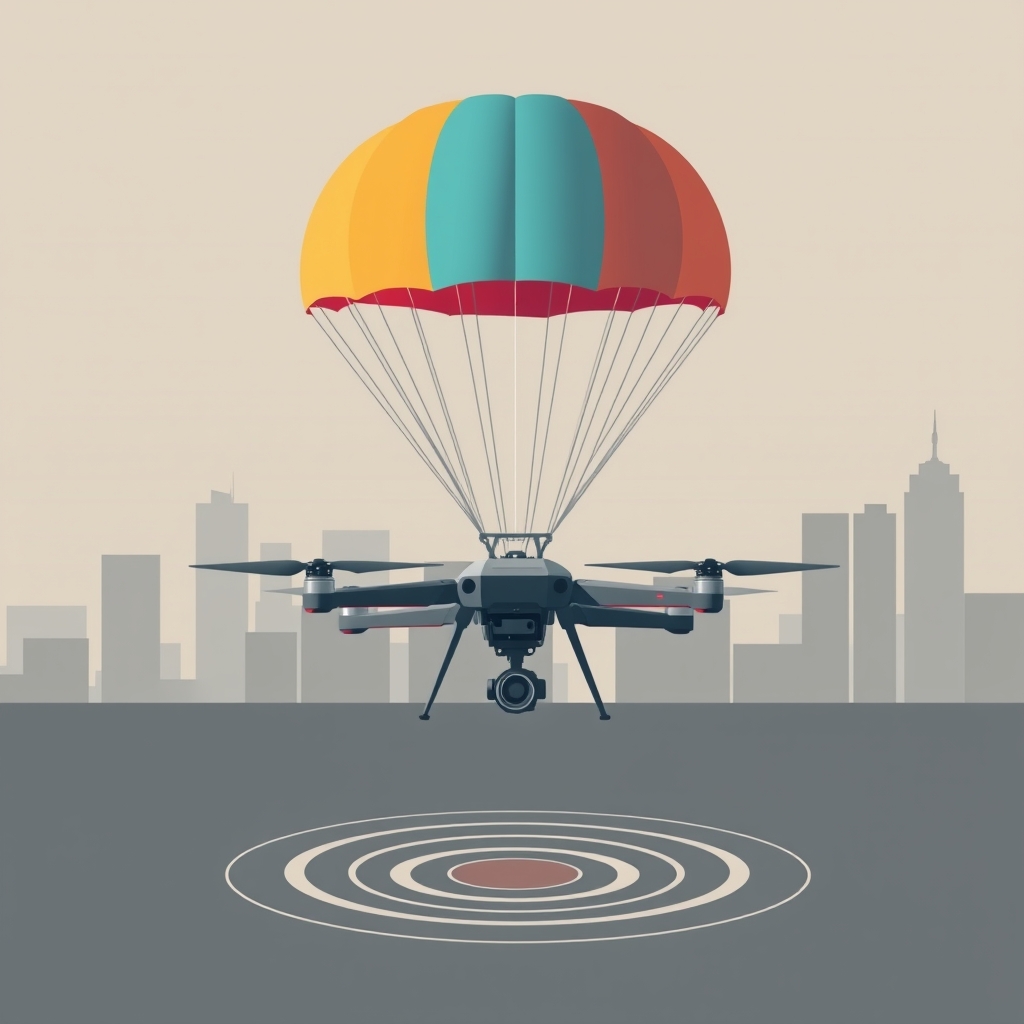
DJI has released the AP100 Parachute, its first dedicated parachute recovery system engineered exclusively for the Matrice 400 — the company's flagship enterprise drone platform. Announced on 8 July 2026, the AP100 is not simply a bolt-on safety accessory: it is a self-contained safety module with its own power supply, flight control system, and termination logic, designed to operate entirely independently of the host aircraft's primary systems.
The timing is deliberate. As enterprise operators push the Matrice 400 into increasingly demanding environments — inspecting infrastructure, conducting search-and-rescue, and mapping urban terrain — regulators in Europe and the UK have set progressively stringent airworthiness criteria for flights over people and beyond visual line of sight (BVLOS). The AP100 is DJI's answer to both the engineering and the regulatory challenge simultaneously.
From the moment the Matrice 400 powers on, the AP100 runs a continuous self-check on its gas generator and communication links, surfacing any anomaly in real time through the Health Management System (HMS) interface in DJI Pilot 2. If the system detects abnormal flight attitude or speed suggesting a loss of control, it triggers an independent Flight Termination System (FTS) that cuts motor power directly via the ESCs, stopping the propellers before the parachute canopy deploys — a design choice that prevents suspension lines from fouling spinning rotors. The entire sequence, from fault detection to canopy ejection, executes in under 600 milliseconds.
Deployment can also be initiated manually via an on-screen slider in DJI Pilot 2, or remotely through FlightHub 2. In EU and UK-supported regions, the system can also trigger automatically when the aircraft breaches a user-defined Geocaging boundary — a feature that regulators in those markets explicitly look for in an approved safety case.
After landing, the AP100 activates audible alarms and high-intensity flashing lights for approximately one hour, helping ground teams locate and recover the aircraft. Operators should note that the AP100 uses a single-use pyrotechnic gas generator and must be fully replaced after any deployment; DJI also recommends retiring the unit three years after activation regardless of self-check status.
The minimum effective deployment altitude is 30 metres — the vertical distance the canopy requires to fully inflate and stabilise descent to below 5 m/s. Below that threshold the chute will still eject, but full inflation and effective braking cannot be guaranteed.
The AP100 is available through authorised DJI Enterprise dealers. TechNode reported a Chinese retail price of 7,488 yuan (approximately $1,100 USD).
Technical Breakdown
Platform: DJI Matrice 400 (M400) — DJI's enterprise flagship, released June 2025. The M400 itself carries a 15.8 kg maximum takeoff weight, up to 6 kg payload capacity across up to seven simultaneous payloads, and up to 59 minutes of forward flight time. Its obstacle-sensing suite combines rotating LiDAR, six-direction mmWave radar, and full-color fisheye vision sensors for power-line-level detection. Transmission is via the O4 Enterprise Enhanced system at up to 40 km range.
UAV Class / MTOW: Heavy enterprise multirotor; 15.8 kg MTOW (preserved with AP100 installed).
AP100 Parachute — Key Specifications:
| Parameter | Value |
|---|---|
| Weight (incl. bracket) | ~935 g |
| Mount position | Rear, via E-Port V2 |
| Deployment time | < 600 ms (detection to ejection) |
| Controlled descent rate | < 5 m/s |
| Minimum effective altitude | 30 m |
| Independent backup power | Dual capacitors; up to 1 hr |
| Operating temperature | −20 °C to +50 °C |
| Environmental rating | IP55 (matches M400 body) |
| Post-deployment alarm | ~1 hr audible + visual |
| Flight time penalty | ~6 minutes |
| Deployment mechanism | Single-use pyrotechnic gas generator |
Propulsion interface: The integrated FTS cuts ESC power within 600 ms, halting rotors prior to canopy ejection.
Autonomy / deployment modes:
- Automatic: triggered by attitude/speed anomaly detection via the AP100's own independent flight control system and sensors.
- Manual: operator-initiated via DJI Pilot 2 on-screen slider.
- Remote: via FlightHub 2 web interface.
- Geocaging-triggered: automatic deployment on boundary breach (supported in EU member states, UK, Norway, Iceland, Switzerland, Liechtenstein, Serbia, and Georgia).
Sensors (AP100-internal): Independent attitude sensors and speed monitors that cross-validate data against the host aircraft in real time, without relying on the M400's primary flight controller or E-Port power connection.
Regulatory certifications (AP100): MOC 2511 / MOC 2512 Declaration of Compliance (EU FTS validation and EU ground risk mitigation validation); F3322 performance standard for small UAS parachute systems.
Industry Impact
For operators: The AP100 provides a direct, first-party pathway to EASA C5/UK5 classification for existing Matrice 400 units — enabling Standard Scenario STS-01 operations (VLOS over populated areas) without a lengthy third-party integration process. For C6/UK6 class status — required for STS-02 BVLOS — operators must procure the factory-certified DJI Matrice 400 (C6) Worry-Free Plus Combo with the AP100 included, or send an existing M400 and AP100 to DJI for retrospective class-marking. This two-tier structure gives both new buyers and existing fleet operators a route to compliance.
For regulators: The AP100's independent power, independent sensing, and independent FTS architecture directly addresses the multi-point redundancy requirements that EASA and the UK CAA articulate in their class-marking standards. The Geocaging-triggered auto-deployment feature further aligns with operational boundary enforcement that regulators increasingly mandate for BVLOS authorisations.
For manufacturers and integrators: This launch signals that DJI is expanding its safety ecosystem beyond the airframe itself — treating regulatory compliance as a product feature. For third-party payload manufacturers, the AP100's rear-mount position and E-Port V2 integration leave the existing four lower E-Port V2 ports fully available, minimising integration conflicts. The native integration also reduces the certification surface area compared with third-party parachute add-ons, which typically require separate testing and documentation.
For investors and fleet operators: The ~935 g weight penalty and approximately six-minute reduction in flight time represent a modest operational trade-off against the ability to fly over people and pursue BVLOS contracts — mission categories that command significantly higher commercial value than standard VLOS operations. The single-use pyrotechnic deployment mechanism and a recommended three-year service life do introduce recurring consumable costs that fleet operators will need to factor into total cost of ownership models.
Broader market signal: Enterprise parachute recovery systems have historically been the domain of specialist third-party vendors. DJI's decision to build and certify its own first-party system for the Matrice 400 — rather than partner with or approve an existing vendor — raises the bar for integration quality and regulatory traceability, and may pressure third-party parachute makers operating in the enterprise segment to accelerate their own certification roadmaps.