
DJI's EV50: the drone giant's first eVTOL cargo aircraft flew supplies to 8,861 m on Everest
DJI's first eVTOL cargo drone, the EV50, carries 50 kg on a compound wing and reached 8,861 m on Everest — preorder in China only for now.
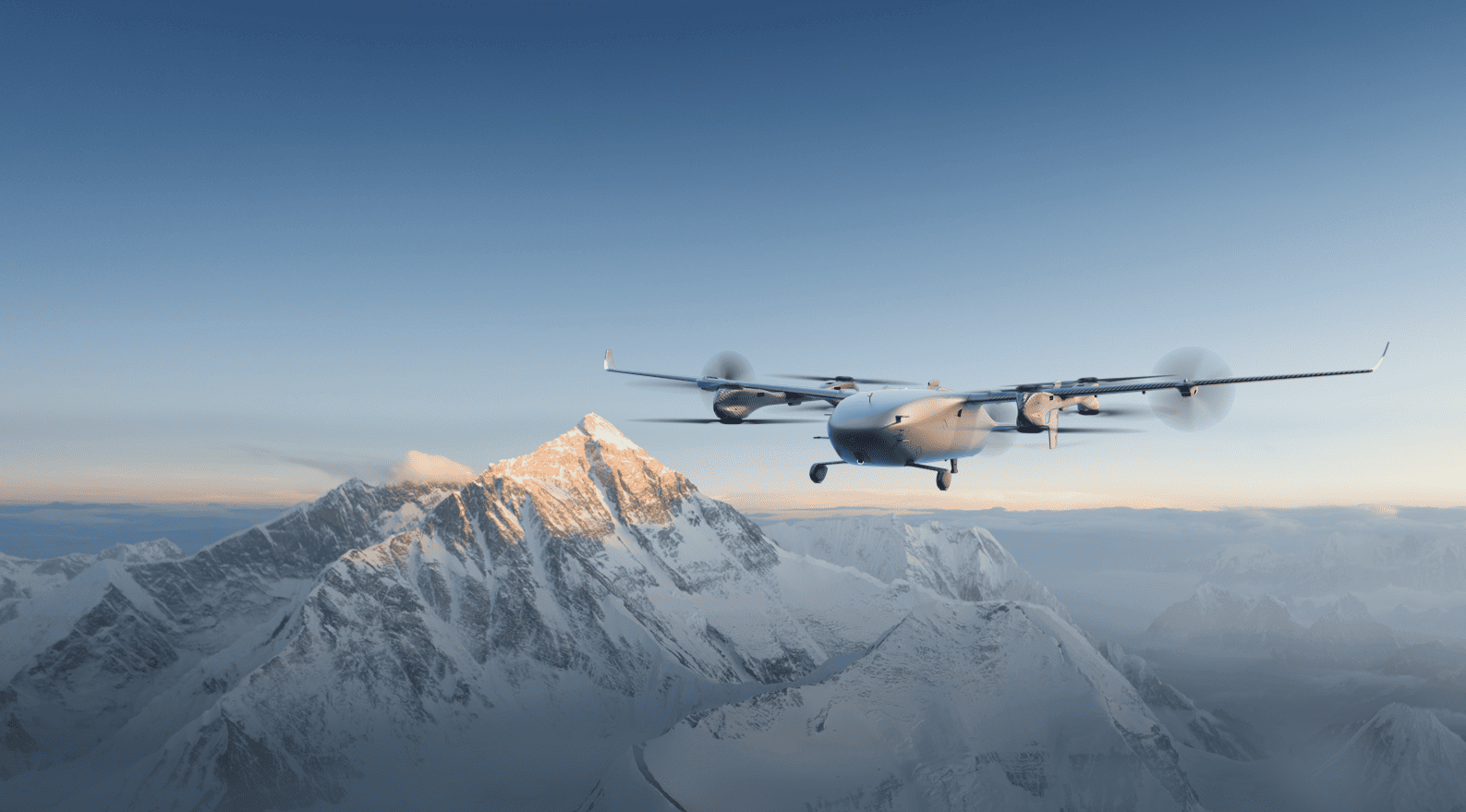
DJI has moved well beyond the quadcopter, unveiling the EV50 — its first electric vertical-takeoff-and-landing (eVTOL) cargo aircraft. Announced in mid-July 2026, the EV50 is a compound-wing design: it lifts off and lands vertically like a multirotor, then cruises like a fixed-wing aeroplane, letting it work in remote places that have no runway. Its public debut was unusually dramatic — a 12-day scientific expedition on Mount Everest, where DJI says the aircraft completed 32 takeoffs and landings, including 12 research flights carrying atmospheric instruments, and reached an operating altitude of 8,861 metres (29,072 feet), roughly the height of Everest's summit, with a continuous climb of 3,730 metres. Being fully electric, it produces no exhaust emissions in flight — a point DJI stresses for high-altitude and environmentally sensitive work.
The aircraft pairs vertical lift from eight rotors with three forward "pusher" propulsion motors, a layout that trades some hover efficiency for the range and speed of a winged design. It carries up to 50 kilograms in a 270-litre cargo hold, tops out at about 160 km/h (99 mph) unloaded, and has a maximum no-load range of 150 kilometres. Reported airframe figures put it near 3.7 metres long with a roughly 7-metre wingspan, and DJI says two operators can fold it to transport size in about five minutes without tools. For redundancy in demanding conditions it carries four independent batteries, dual thermal-management systems, an anti-icing pitot tube, and an emergency parachute.
For now, availability is limited: the EV50 is listed for preorder in mainland China only, and DJI has not announced international pricing or a launch timeline. The company frames the aircraft around emergency response, mountain and island logistics, and scientific expeditions — missions where a runway-free, long-range electric lifter could stand in for far costlier helicopter trips.
Technical Breakdown
- Platform / class: compound-wing eVTOL fixed-wing cargo drone
- Propulsion: 8 vertical-lift rotors + 3 forward pusher motors; fully electric
- Payload: up to 50 kg; 270-litre cargo compartment
- Range / speed: 150 km maximum (no load); ~160 km/h top speed (unloaded)
- Airframe: ~3.7 m length, ~7 m wingspan; folds to transport size in ~5 minutes, no tools [Unconfirmed: airframe dimensions reported by secondary outlets, not in DJI's primary spec sheet]
- Cold-weather redundancy: four independent batteries, dual thermal-management systems, anti-icing pitot tube, emergency parachute
- Demonstrated ceiling: 8,861 m operating altitude on Everest; 3,730 m continuous climb
Industry Impact
The EV50 is DJI's clearest step yet beyond camera and consumer drones into heavy-lift logistics, placing it in a crowded field of eVTOL cargo developers. A compound-wing aircraft that needs no runway, carries 50 kg, and runs on batteries targets precisely the missions where helicopters are expensive and small multirotors run out of range — remote resupply, disaster response, and island or mountain delivery. For operators, the draw is a lower cost-per-flight and simpler field deployment; a tool-free five-minute fold and four-battery redundancy are aimed squarely at expedition and emergency crews working far from hangars.
For regulators and integrators, a 50 kg electric aircraft flying beyond visual line of sight through complex terrain raises the familiar technical questions of airworthiness certification, BVLOS approval, and airspace integration — the factors that will determine where and how quickly it can be flown. The initial China-only preorder mirrors the usual rollout pattern for DJI hardware: available at home first, with wider availability contingent on airworthiness and regulatory approval in each market.