
DJI Splits Its Beginner Line With the Lito Series — Launched Worldwide, Locked Out of the US
DJI's Lito 1 and Lito X1 bring LiDAR, 10-bit 4K and 36-min flight to sub-250g beginner drones — launched globally but not in the US.
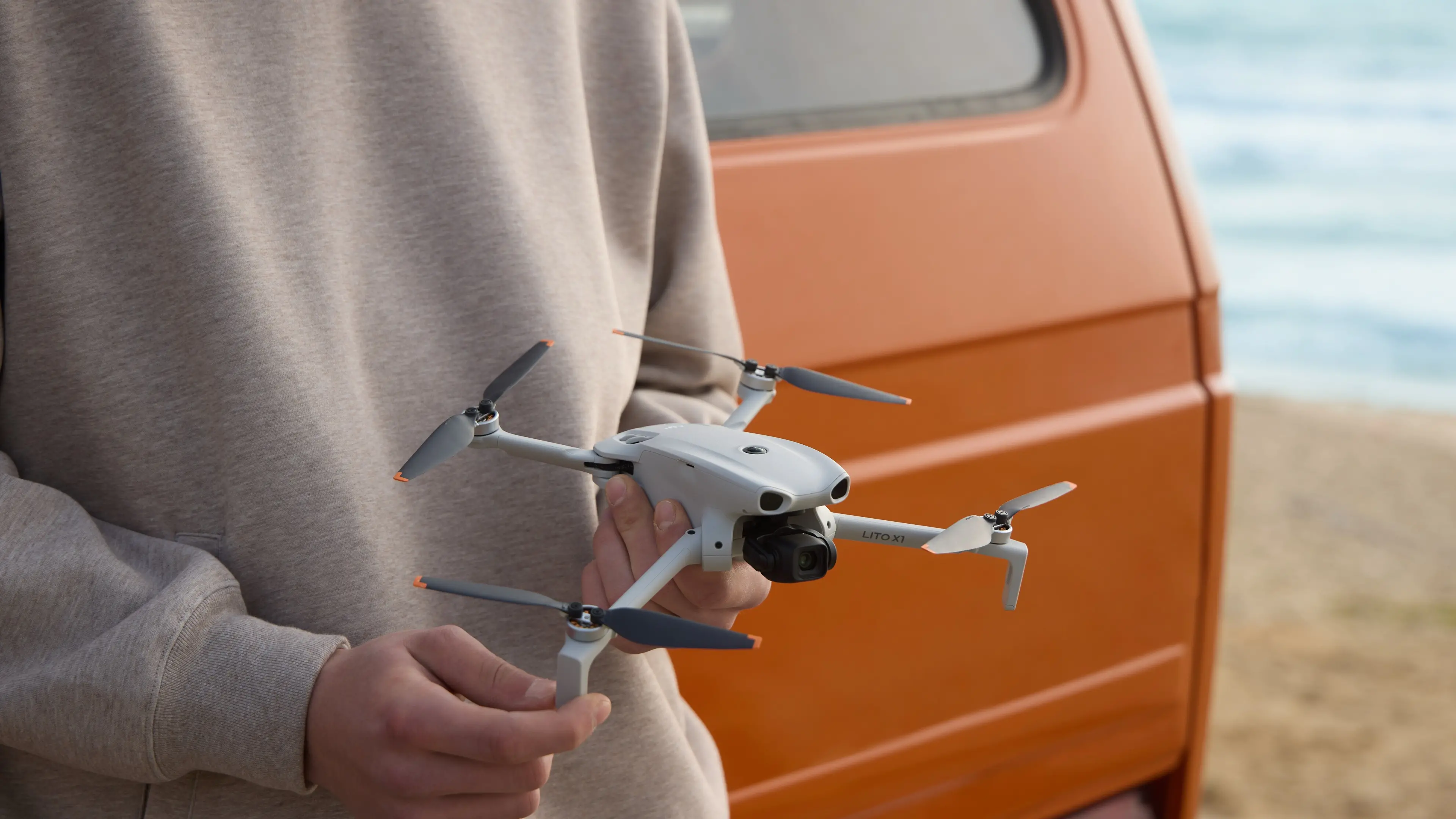
DJI introduced a new entry-level drone family, the Lito series, on 23 April 2026, with order availability opening the same week through the company's own store and authorised retailers. The launch is notable less for any single headline specification than for how DJI has restructured the bottom of its consumer range. Rather than iterating once more on the long-running Mini line, the company split the beginner tier into two distinct products: the Lito 1, positioned as a straightforward, low-cost route into aerial photography, and the Lito X1, a more capable variant aimed at users who want image quality and flight-safety features that will not feel limiting within a few months of ownership.
Both aircraft are sub-249g folding drones built on the same external airframe, with optional removable propeller shrouds for added obstacle protection. The shared weight class matters: under 250g, these drones fall outside the registration and certification requirements that apply to heavier platforms in most jurisdictions, including India's DGCA Nano category for recreational flying in permitted zones. Multiple independent reviews characterised the Lito X1 as the strongest beginner option in the segment at launch, primarily on the strength of its sensor, obstacle-avoidance suite and onboard storage — features that, until recently, were reserved for considerably more expensive models. Reviewers also flagged the standard caveat that real-world endurance runs roughly 25 minutes against DJI's 36-minute rating, consistent with the company's other small drones.
The central strategic point is geographic. The Lito series launched across Europe, India and other international markets but not in the United States. Reporting tied the US absence to DJI's placement on the FCC Covered List, which blocks new DJI models from clearing the equipment-authorisation pathway needed for legal import and sale. DRONELIFE reported that DJI has estimated it could lose more than US$1.5 billion in 2026 from its inability to sell new products in the US — context that reframes the Lito launch as part of a now-established pattern of DJI shipping globally while treating the US as a closed market. [Unconfirmed: one review reported that the Lito line now serves as DJI's entry-level open-prop range and that the Mini series will no longer be updated; DJI has not formally confirmed discontinuation of the Mini line.]
Technical Breakdown
- UAV class: Sub-250g consumer/prosumer folding camera drone; two models (Lito 1, Lito X1).
- Weight: Under 249g for both (with standard intelligent flight battery).
- Sensor / camera: Lito 1 — 1/2-inch CMOS, 48MP, f/1.8 aperture, up to 8K photo and 4K video. Lito X1 — larger 1/1.3-inch CMOS, 48MP effective, 10-bit 4K up to 60fps with D-Log M and ~14 stops of dynamic range.
- Gimbal: 3-axis mechanical stabilisation on both.
- Obstacle sensing / autonomy: Omnidirectional obstacle sensing on both; Lito X1 adds a forward-facing LiDAR sensor for improved low-light detection. Automated modes include ActiveTrack, Spotlight and waypoint flight; quick-takeoff without waiting for a satellite fix; vision-assisted Return-to-Home (LiDAR-aided on the X1).
- Storage: Lito X1 — 42GB internal plus microSD; Lito 1 — microSD only (no internal storage).
- Transmission / range: DJI O4 video link, 1080p/60fps live view, rated up to ~15km (FCC/IC) and 8km (CE). QuickTransfer file offload over Wi-Fi 6 at up to 50 MB/s.
- Endurance: Up to 36 minutes on the standard Intelligent Flight Battery; up to 52 minutes with the Intelligent Flight Battery Plus (not offered in the EU/UK). Real-world ~25 minutes per reviewers.
- Controllers: Compatible with DJI RC-N3 (requires a phone) and RC 2 (built-in screen); Lito 1 bundles centre on the RC-N3, while the X1 offers RC 2 configurations.
- Indicative pricing: Lito 1 from approximately US$419; Lito X1 from approximately US$519, rising to around US$979 for the top combo (EU pricing for the X1 around €379). Currency and configuration vary by region.
Industry Impact
For DJI, the Lito split is a margin and segmentation play. By dividing the entry tier into a stripped-down model and a feature-rich one separated by a modest price gap, DJI nudges first-time buyers toward the higher-margin X1 while still defending the absolute-lowest-price slot against rivals. The presence of LiDAR, 10-bit capture and internal storage at this price point compresses the gap between budget and flagship sub-250g drones, which raises the baseline that competitors must match to stay relevant in the beginner category.
For operators and integrators, the more consequential signal is the hardening US-versus-rest-of-world divide. The Lito series is the latest DJI product engineered, certified and distributed for everywhere except the United States. US-based service providers and resellers gain nothing from this launch and must continue sourcing from prior-authorised inventory or pivot to non-Chinese platforms, while operators in Europe, India and other markets get immediate access to a cheaper, more capable entry tier. For Indian manufacturers and integrators specifically, the sub-250g positioning is double-edged: it lands in the recreational Nano segment where domestic competition is thin, sharpening the price-performance benchmark that local entry-level products are measured against, even though import restrictions limit how freely such units circulate through formal channels.
For regulators, the Lito launch underscores how the sub-250g weight threshold is shaping product design as much as any optical or flight specification. DJI is deliberately engineering capability up to — but not past — the registration-exempt limit, concentrating advanced sensing and imaging into a class that sidesteps remote-pilot certification in most markets. That trend has implications for airspace authorities weighing whether weight-based exemptions remain an appropriate proxy for risk as sub-250g drones acquire LiDAR, longer range and increasingly autonomous flight behaviour.
For investors, the recurring US$1.5-billion-scale figure attached to DJI's US exclusion is the throughline. Each globally-but-not-US launch widens the addressable-market gap between DJI's international business and the vacuum it leaves in the US — a vacuum that domestic and allied manufacturers are positioned to fill, provided they can close the price-performance distance that products like the Lito X1 keep extending.