
FLYNN: When a Fruit Fly's Brain Teaches Robots to Navigate Blind
FLYNN trains an RNN on the Drosophila fruit fly brain connectome for robot navigation — and outperforms hand-crafted nets under total sensor loss.
Main Story
For all the sophistication of modern deep learning, autonomous navigation systems share a disquieting fragility: encounter an environment that looks nothing like the training data, or lose a sensor, and performance collapses. Biological nervous systems, by contrast, absorb novel conditions and partial sensory loss with remarkable grace. A new paper from arXiv (2607.00025) now offers one possible engineering answer to that gap — not by tweaking a conventional architecture, but by wholesale borrowing the wiring diagram of a fruit fly's brain.
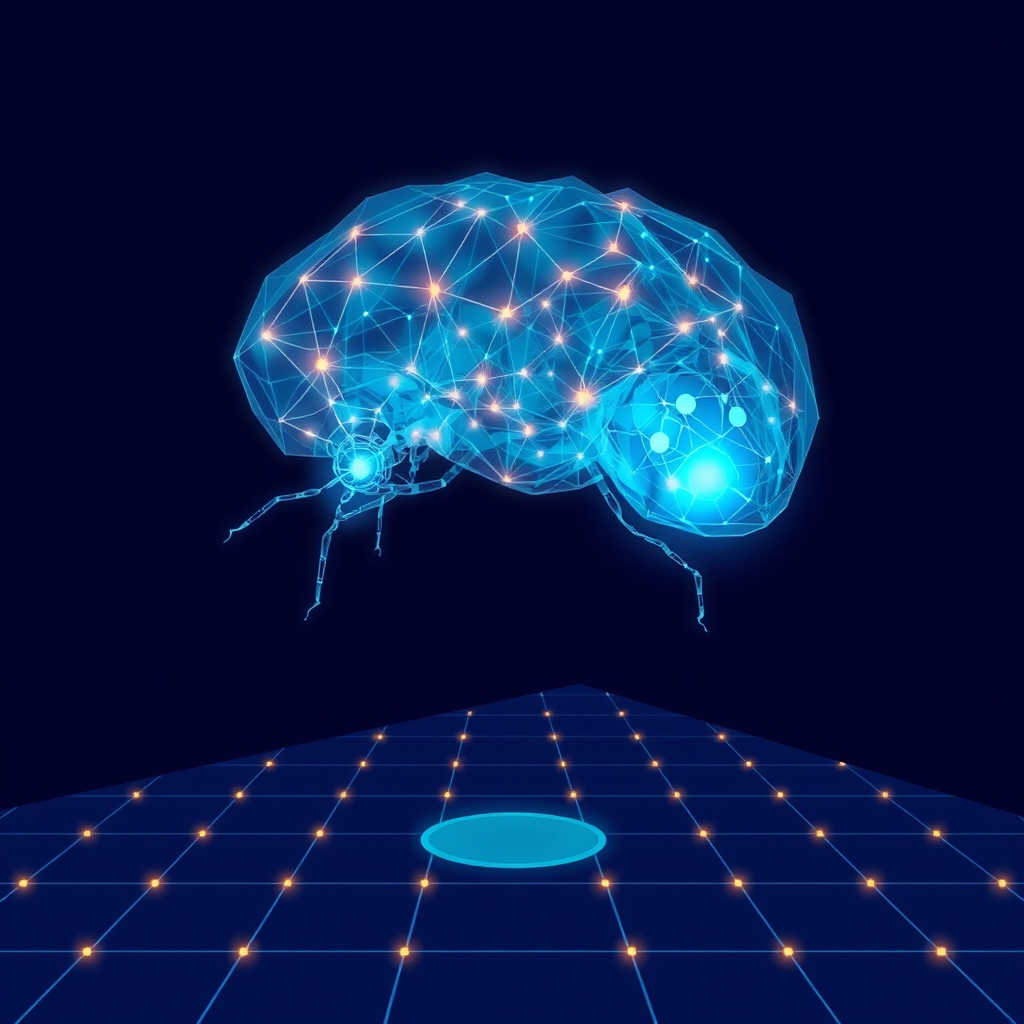
The system is called FLYNN (Fly connectome Neural Network). Its architecture is not hand-designed; it is a recurrent neural network (RNN) whose connectivity pattern is drawn directly from the synaptic-resolution connectome of Drosophila melanogaster. The FlyWire project previously produced the first complete connectome of an adult Drosophila melanogaster brain, a map that encompasses roughly 140,000 neurons and 50 million synapses. FLYNN does not simulate every one of those neurons — it uses the topology of the connectome as a structural prior for the RNN's recurrent connections, constraining how information flows through the network in the same pattern that evolution encoded over millions of years.
The researchers trained FLYNN to perform vision-based navigation tasks inside the MuJoCo physics simulation environment — a widely used robotics benchmark that tests continuous, real-time motor control from visual input. On standard in-distribution tasks, FLYNN achieved performance comparable to modern hand-crafted networks with equivalent parameter counts, confirming that the biological topology does not simply sacrifice task capability for robustness.
The more significant findings emerge when conditions become adversarial. FLYNN exhibits superior resistance to out-of-distribution (OOD) data — environments and visual inputs that differ substantially from those seen during training. More strikingly, it demonstrates tolerance to sensory loss without any further training. When the camera feed was cut entirely, FLYNN continued to navigate; hand-crafted baseline networks largely failed under the same total-vision-loss condition, even when those baselines had been specifically trained with camera dropout as a deliberate regularisation technique. This is a meaningful engineering distinction: conventional dropout-based robustness strategies did not close the gap that biological topology delivered for free.
To understand why, the authors applied Principal Component Analysis to FLYNN's internal activation states. The results suggest that FLYNN develops a particularly high degree of representational modularity — different functional sub-computations appear to be relatively isolated from one another within the network. The researchers propose that this modularity, which mirrors the modular organisation observed in the Drosophila central complex (CX), may underpin the network's fault tolerance: damage or loss of one input channel does not cascade catastrophically through tightly coupled representations.
This connects to a well-established body of neuroscience. The Drosophila CX is a recurrent brain region whose circuits enable directed locomotion, context-dependent spatial navigation, and head-direction computation. Electron-microscopy-based connectomics of the CX has previously identified network motifs that allow the fly to extract head direction, maintain it with attractor dynamics, and combine it with other sensorimotor signals for vector-based navigation — exactly the class of computation FLYNN is now being asked to perform in simulation.
FLYNN is not the first bio-inspired network to demonstrate OOD navigation robustness. Liquid neural networks — continuous-time models inspired by the nematode C. elegans nervous system — previously demonstrated robust vision-based fly-to-target performance under drastic distribution shifts in drone flight (Science Robotics, 2023). FLYNN's contribution is distinct: it derives its structure from a far more complex connectome and demonstrates resilience to complete sensor loss, a regime where liquid networks were not specifically evaluated. Together, these results reinforce a broader hypothesis: that topology drawn from biological neural architectures encodes computational priors that are difficult to replicate with hand-designed regularisation alone.
Technical Breakdown
| Parameter | Detail |
|---|---|
| Network type | Recurrent Neural Network (RNN) |
| Architecture source | Synaptic-resolution connectome of Drosophila melanogaster (FlyWire dataset, ~140K neurons / 50M synapses reference brain) |
| Topology usage | Connectome wiring used as structural prior for recurrent connectivity; parameter count matched to hand-crafted baselines for fair comparison |
| Simulation environment | MuJoCo physics engine — vision-based continuous-control navigation tasks |
| Sensory modality | Visual (camera) input; tests conducted under full-vision and total-vision-loss conditions |
| Robustness benchmarks | Out-of-distribution (OOD) environments; sensory deprivation without retraining; camera dropout vs. baseline |
| Interpretability method | Principal Component Analysis (PCA) of internal activation states |
| Key emergent property | High representational modularity — proposed mechanism for fault tolerance |
| Autonomy level | Fully autonomous navigation agent (no human-in-the-loop during inference) |
| Training paradigm | Standard gradient-based training of the connectome-constrained RNN |
Industry Impact
For UAV and robotics autonomy developers: FLYNN's central result — that connectome-derived topology delivers sensor-loss tolerance without retraining — directly addresses one of the hardest operational failure modes for autonomous aerial systems: camera occlusion, damage, or adverse weather. If the findings generalise beyond MuJoCo to real-world sim-to-real transfer, this could reduce dependence on expensive sensor-redundancy hardware by building resilience into the policy network's architecture.
For AI and autonomy researchers: The paper adds a concrete data point to the emerging field of connectome-based AI. Prior work, including liquid neural networks and neuromorphic simulation of the full Drosophila connectome on Intel Loihi 2, established the feasibility of running biological wiring at scale. FLYNN demonstrates that structural priors from connectomics can be extracted and applied selectively — using topology without requiring full biophysical fidelity — and still yield measurable engineering benefits over hand-crafted baselines.
For chip and neuromorphic hardware developers: The representational modularity identified in FLYNN through PCA maps naturally to sparse, recurrent, and irregular connectivity structures — precisely the characteristics that make biological circuits challenging for conventional dense-linear-algebra hardware. Neuromorphic platforms designed to handle such graph topologies are better positioned to accelerate connectome-derived networks efficiently.
For regulators and certification bodies: Current UAV airworthiness frameworks assess fault tolerance primarily at the hardware and sensor level. An architecture that demonstrates behavioural continuity under total sensor loss — purely as a property of its neural topology — raises new questions about how software-level fault tolerance should be characterised, tested, and credited in certification processes such as EASA's AI roadmap or FAA's Means of Compliance for machine learning.
Near-term limitations to watch: All results are from simulation. Sim-to-real transfer of connectome-derived RNNs — particularly under the timing constraints of real embedded flight hardware — has not been demonstrated. The parameter-count matching methodology used to compare FLYNN against hand-crafted baselines also warrants independent replication across a wider range of task environments before operational conclusions are drawn.