
GPAC: How Implicit Coordination Could Unlock Truly Scalable Multi-Drone Cargo Lifts
GPAC: a decentralised 4-layer geometric controller lets N quadrotors lift a cable-suspended payload with no central coordinator and just 33.8 cm RMSE.
Main Story
Cooperative aerial transport — multiple drones sharing the load on a single suspended payload — is one of the more demanding problems in UAV autonomy. The physics are unforgiving: the payload swings, cables go slack, wind perturbs every agent simultaneously, and the combined forces from all rotors must sum to exactly what the payload needs. Most architectures that work solve this by putting a central coordinator in the loop, or at minimum by having every agent broadcast its cable state and adaptive parameters to its teammates. That communication dependency limits scalability and creates a single point of failure.
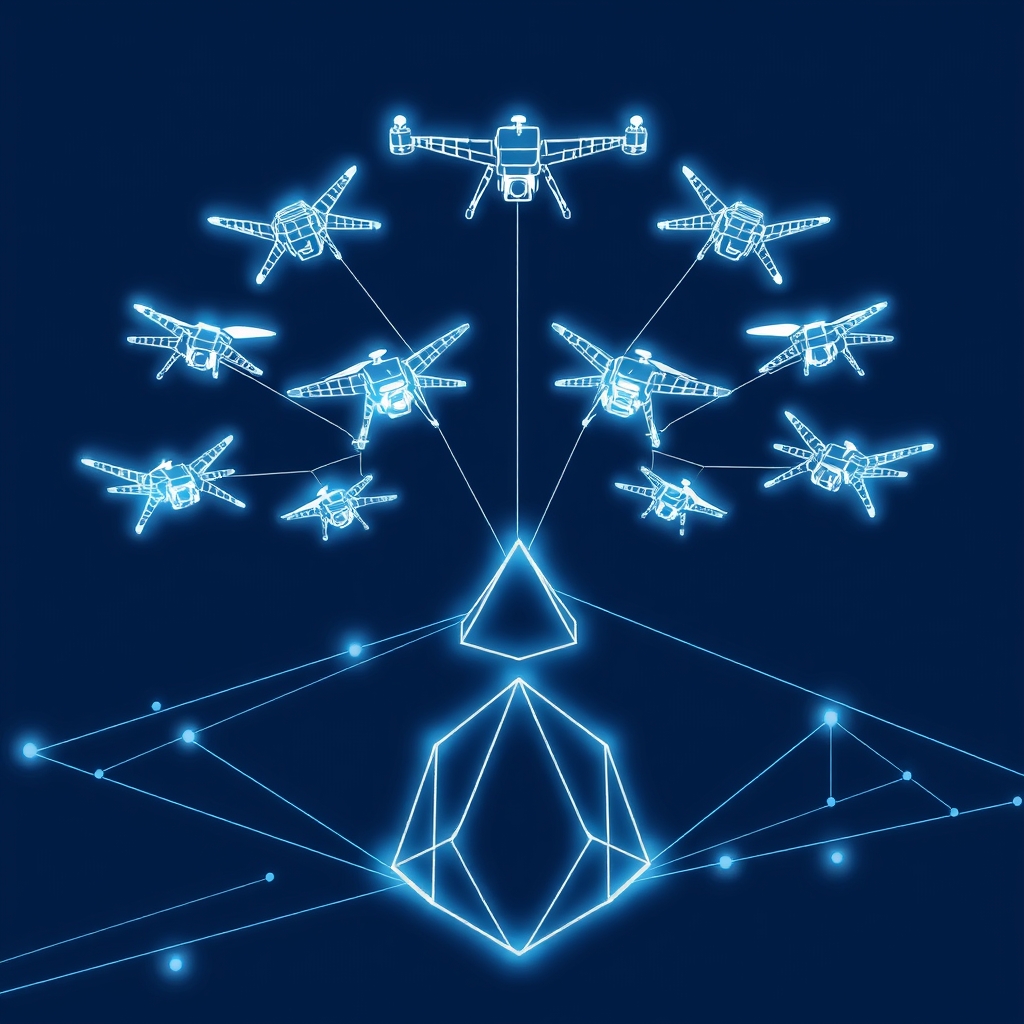
A paper submitted to arXiv in July 2025 (arXiv:2607.00024) proposes a different approach. The researchers introduce GPAC — a four-layer hierarchical architecture designed to let N quadrotors transport a cable-suspended payload without a central coordinator and without exchanging cable states or adaptive parameters between agents. The core insight the authors term implicit coordination: rather than telling each drone how much of the total load it should carry, each quadrotor independently estimates its own effective load share from local cable angle measurements. The mathematics are constructed so that, when all agents do this simultaneously, their combined forces converge to the correct total — even when no individual agent knows N or the total payload mass.
Payload position is similarly reconstructed locally. Each quadrotor infers where the payload is from its own cable geometry, not from a shared state estimate. The only inter-agent communication GPAC requires is a low-rate broadcast of neighbour positions, used exclusively for collision avoidance — a dramatically thinner communication budget than prior art.
The broader multi-drone payload transport field has been active. Centralised approaches have demonstrated trajectory tracking and formation maintenance, but rely on full state sharing and are difficult to scale. More recent work on decentralised controllers — including Lyapunov-based methods and optimisation-based cable-force allocation — has narrowed the gap, yet most still assume either known payload mass or persistent communication channels. GPAC's implicit load-sharing mechanism addresses both gaps simultaneously.
Four Layers, One Manifold
GPAC operates directly on the full nonlinear configuration manifold — it does not linearise the system dynamics. Its four layers integrate:
- Geometric position and attitude control on SO(3), preserving the rotational geometry of the quadrotor rather than approximating it with Euler angles or unit quaternions.
- Anti-swing regulation, which actively damps cable pendulum modes.
- An extended-state observer (ESO) for wind rejection, estimating and compensating aerodynamic disturbances in real time.
- Concurrent learning-based mass estimation that converges without requiring persistent excitation (PE) — meaning the estimator does not need the system to be continuously and richly excited to identify the payload mass. Concurrent learning, as established in the adaptive control literature, achieves parameter convergence by using both recorded and instantaneous data concurrently, replacing the PE condition with a weaker linear-independence condition on stored data.
A priority-ordered control barrier function (CBF)-inspired safety filter sits atop these layers. The filter modifies the desired thrust force when safety constraints are active. A key compatibility result in the paper shows that these force modifications keep the desired attitude within the almost-global stability region of the SO(3) attitude controller — meaning the safety layer does not destabilise the rotational controller. Input-to-state safety (ISSf) margins are proven to hold exactly under single-constraint activation, providing formal guarantees analogous to those formalised in the ISSf-CBF literature.
Simulation Results
The authors validated GPAC in high-fidelity simulation with flexible cable models, onboard sensor fusion, and wind turbulence — with all control and estimation loops closed through the estimator, not through ground-truth state injection. Across 13 randomised simulation seeds, the mean payload-tracking root-mean-square error (RMSE) was 33.8 cm, with a coefficient of variation of 2.8% — indicating low variance across trials. The researchers report this at a low per-agent computational cost, which they argue supports onboard deployment at scale.
Technical Breakdown
| Parameter | Detail |
|---|---|
| Platform class | Multi-quadrotor (N agents, architecture is agent-count agnostic) |
| Payload configuration | Flexible cable-suspended rigid payload |
| Control manifold | Full nonlinear SO(3) configuration manifold |
| Architecture layers | 4-layer hierarchical (geometric position/attitude → anti-swing → ESO wind rejection → mass estimation) |
| Safety layer | Priority-ordered CBF-inspired filter with ISSf margins (single-constraint activation) |
| Mass estimation | Concurrent learning-based adaptive estimator; converges without persistent excitation |
| Payload localisation | Local per-agent reconstruction from own cable geometry; no shared state |
| Inter-agent comms | Low-rate neighbour-position broadcast for collision avoidance only |
| Wind rejection | Extended-state observer (ESO) |
| Simulation fidelity | Flexible cables, onboard sensor fusion, wind turbulence; all loops closed through estimator |
| Tracking performance | Mean payload RMSE: 33.8 cm (CV: 2.8% over 13 seeds) |
| Autonomy level | Fully onboard decentralised; no central coordinator required |
Industry Impact
For drone manufacturers and integrators: GPAC's architecture points toward multi-rotor lift systems that can be composed modularly — adding or removing vehicles without re-tuning a central planner. This is directly relevant to heavy-lift slung-load applications in construction, emergency logistics, and infrastructure inspection, where teams of mid-class quadrotors could substitute for a single large rotorcraft. The low per-agent compute requirement is a meaningful signal that the architecture is designed for commodity flight computers, not research-grade workstations.
For operators: The elimination of a central coordinator removes a single point of failure that has been a practical concern in multi-UAV lift operations. The lean communication model — neighbour positions only — also reduces RF spectrum load and simplifies frequency coordination in contested or congested airspace.
For regulators and certification bodies: The formal ISSf safety margins and the SO(3) compatibility proof represent the kind of analytical safety evidence that increasingly features in certification discussions for autonomous systems. As regulators in multiple jurisdictions develop frameworks for beyond-visual-line-of-sight and autonomous cargo operations, architectures that can produce verifiable safety bounds under disturbances will be better positioned for approval pathways than those relying solely on empirical test data.
For researchers and algorithm developers: The concurrent learning mass estimator — which removes the persistent excitation requirement — addresses a long-standing practical limitation in adaptive UAV control. Most real transport missions do not provide the rich, persistently exciting manoeuvres that classical adaptive laws require for parameter convergence; this approach relaxes that constraint using stored data, which is a meaningful step toward deployment-ready adaptive controllers.
For investors: The scalability claim — N agents, no knowledge of N required — is commercially significant. It suggests a path to systems where fleet size is a run-time variable rather than a design-time constant, enabling dynamic allocation of lift capacity across missions. Hardware validation will be the next critical milestone to watch.