
LabEvolver: Peking University's Dual-Loop Framework Teaches Robotic Lab Agents to Learn by Doing — Without Any Retraining
Peking University's LabEvolver cuts robotic wet-lab task time by 48.2% and boosts ALFWorld success to 91.4% — no retraining required.
Main Story
Automating scientific laboratory work has long demanded more than precise actuators — it demands agents that can perceive a dynamic physical environment, plan safe action sequences, and improve without the cost and downtime of model retraining. A team from Peking University's Schools of AI for Science, Electronic and Computer Engineering, and Computer Science is proposing a new answer.
Their system, LabEvolver, is a training-free framework designed specifically for robotic wet-lab agents. Rather than updating model weights after each experiment, LabEvolver accumulates structured experience from completed task trajectories and makes that experience available to future executions — a design the authors describe as "learn-by-doing experience evolution."
The paper, filed under Robotics (cs.RO) and Artificial Intelligence (cs.AI) on arXiv and authored by Jingya Wang, Yuyang Gao, Liuzhenghao Lv, Yonghong Tian, and Yuyang Liu, was posted to arXiv on 30 July 2026.
The Dual-Loop Architecture
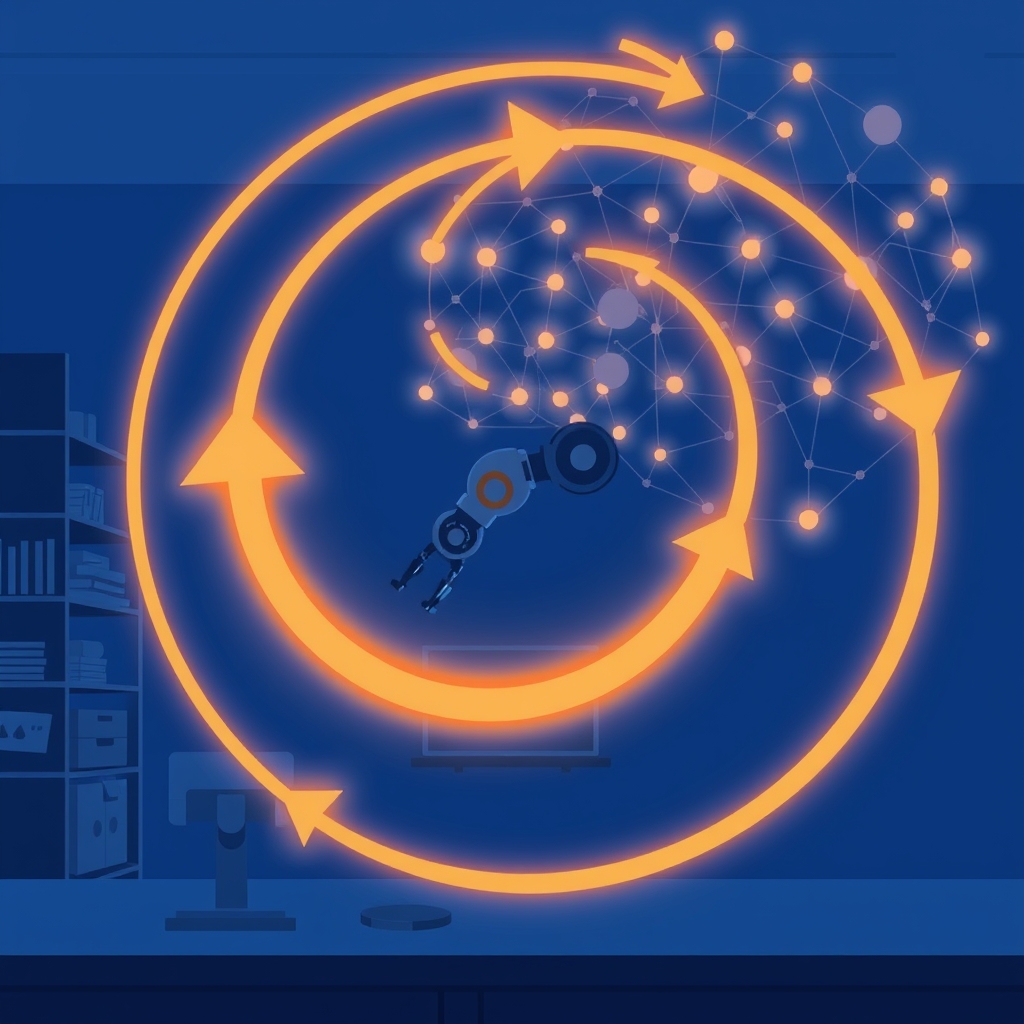
LabEvolver's core design separates execution from learning through two nested loops. The inner trial loop is state-grounded, meaning the agent anchors perception and planning decisions to real-time laboratory state rather than to static pre-encoded assumptions. This loop handles adaptive perception, online planning, and safety validation as the robot operates. The outer evolution loop takes a longer view: once a task trajectory is complete, it distills that experience into three categories of reusable knowledge — skill experience (how to perform an action), strategy experience (when and why to apply it), and safety experience (which conditions to avoid or flag). Future task runs can retrieve relevant items from this growing store without any gradient-based update to the underlying model.
The architecture addresses a persistent tension in autonomous laboratory robotics: real lab environments present physical variability — reagent concentrations, instrument states, ambient conditions — that generic pretrained representations handle poorly. By grounding the inner loop in observed state and externalising learned experience to a queryable memory, LabEvolver allows the agent to adapt to this variability on an ongoing basis.
Real-World Wet-Lab Results
The team evaluated LabEvolver on robotic solution-preparation tasks, a class of wet-lab operations that includes measuring, mixing, and chemically adjusting solutions. The headline results: LabEvolver reduced pH-regulation task completion time by 48.2% and lowered safety-gate intercepts — instances where the safety validation layer blocked a planned action — by 60.0%. Both figures are against the same robot operating without the evolution framework. The reduction in safety-gate intercepts is particularly notable, because it reflects the agent progressively internalising which action sequences are safe, rather than repeatedly attempting and being blocked on similar operations.
Generalisation to ALFWorld
To assess whether the outer-loop distillation mechanism is domain-specific or a broadly applicable embodied-agent technique, the researchers also tested on ALFWorld — a benchmark that bridges text-based symbolic reasoning with embodied task execution in interactive environments. LabEvolver improved cumulative task success rate within 20 steps from 76.2% using the ReAct baseline to 91.4% over a run of 500 continual tasks. This 15.2-percentage-point gain over 500 tasks, without any model weight updates, suggests the outer evolution loop functions as a general embodied-cognition mechanism rather than a wet-lab-specific patch.
The authors frame this as evidence that experience-based evolution is a viable architectural direction for closed-loop automated scientific discovery — a category of systems where the robot or agent must not only execute known protocols but refine its own operating knowledge through physical interaction.
Broader Context
LabEvolver arrives amid intensifying activity in AI-driven laboratory automation. Parallel efforts such as the MARS multi-agent platform (published in Matter in early 2026) have demonstrated closed-loop materials discovery by coordinating LLM agents with robotic execution. What distinguishes LabEvolver is its explicit focus on safety evolution alongside skill evolution — treating safe operation not as a fixed ruleset but as an evolving body of experience that the agent refines through practice. The project page and code are publicly available.
Technical Breakdown
| Parameter | Detail |
|---|---|
| Framework type | Training-free, dual-loop agent framework |
| Primary domain | Robotic wet-lab automation (solution preparation, pH regulation) |
| Inner loop functions | State-grounded adaptive perception, online planning, safety validation |
| Outer loop functions | Trajectory distillation into skill, strategy, and safety experience stores |
| Memory architecture | Episodic memory populated from completed execution trajectories; no gradient updates |
| Autonomy level | Continual self-improving autonomous agent; no human intervention required per task |
| Real-world benchmark | pH-regulation solution-preparation tasks (robotic platform) |
| Simulation benchmark | ALFWorld (500 continual tasks, 20-step evaluation window) |
| Key metrics | −48.2% task completion time; −60.0% safety-gate intercepts; +15.2 pp success rate vs. ReAct on ALFWorld (76.2% → 91.4%) |
| Institution | Peking University (Schools of AI for Science, Electronic and Computer Engineering, Computer Science) |
| Preprint | arXiv:2607.27690, cs.RO / cs.AI, 30 July 2026 |
Industry Impact
For robotic lab integrators and self-driving laboratory builders: LabEvolver's training-free design is practically significant. Conventional fine-tuning pipelines require curated datasets, compute infrastructure, and operational downtime — barriers that make continuous improvement difficult in running lab facilities. A framework that improves performance purely through experience distillation could lower the engineering cost of deploying adaptive robotic chemists and biologists substantially.
For safety and compliance engineers: The 60.0% reduction in safety-gate intercepts over time indicates that safety knowledge can be systematically accumulated and reused, rather than relying solely on hard-coded rules or conservative default policies. This has implications for how certifiers and standards bodies might evaluate adaptive robotic lab systems — moving from static safety case arguments toward frameworks that account for an agent's evolving operational competence.
For AI platform and foundation-model vendors: The generalisation results on ALFWorld suggest the outer evolution loop is model-agnostic and task-agnostic. This positions experience-distillation layers as add-on modules that vendors could offer atop existing LLM or vision-language-action foundations, without requiring customers to retrain base models.
For researchers and benchmark developers: LabEvolver's application to ALFWorld raises the bar for continual-task performance on that benchmark and signals demand for richer evaluation protocols — particularly ones that measure how agent performance evolves over long task sequences rather than snapshotting single-episode accuracy.
For investors in lab-automation startups: The combination of measurable cycle-time reduction and safety metric improvement on real hardware provides the kind of dual productivity-safety proof point that enterprise laboratory customers typically require before committing to autonomous robotic systems. Frameworks that can demonstrate both on physical equipment will accelerate procurement cycles.