
Mojave STOL Drone Conducts First Battlefield Short-Field Operations in South Korea
GA-ASI's Mojave STOL makes history as the first MALE UAS to land and relaunch from a simulated battlefield in South Korea, advancing the Gray Eagle ST
Main Story
On September 16, 2026, General Atomics Aeronautical Systems (GA-ASI) and its South Korean partner Hanwha Aerospace announced a landmark in unmanned aviation: the Mojave STOL UAS conducted what GA-ASI describes as the first-ever flight operations from a simulated battlefield by a medium-altitude, long-endurance uncrewed aircraft.
The demonstration took place at a live-fire training range of the Republic of Korea (ROK) Army, north of Seoul, during the Defense Drone Technology Exhibition. More specifically, the demo took place at the runway of ROK Army 513th Aviation Battalion and the Seungjin Training Field in Pocheon-si.
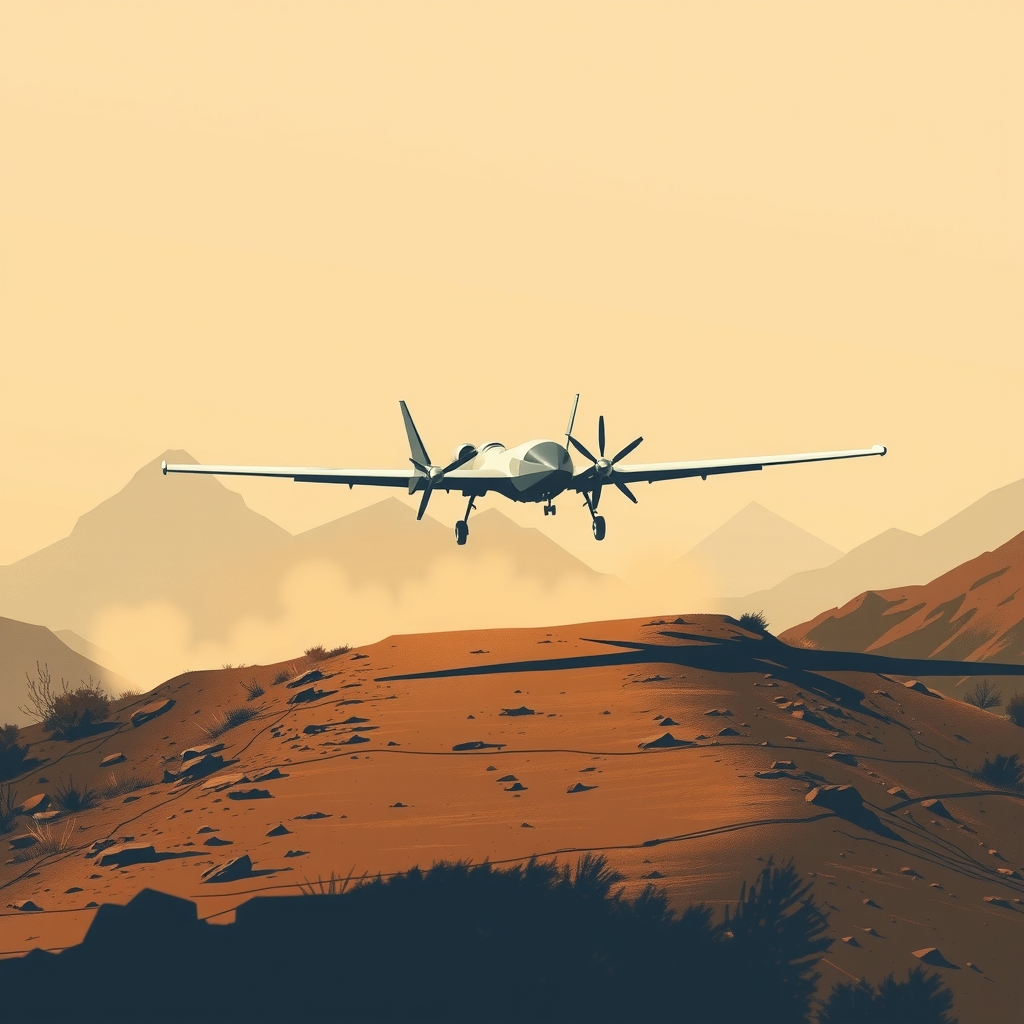
The operational sequence itself was carefully structured to replicate forward-deployment conditions. Under the control of pilots operating from ground control stations, Mojave took off from a conventional runway at ROK Army 513th Aviation Battalion, flew to the Seungjin Training Field where it joined air operations, then landed on a rough maneuver trail used mostly by ROK Army tanks and artillery vehicles. The aircraft then took back off again, resumed operations, and returned to ROK Army 513th Aviation Battalion.
The Mojave STOL completed its flight sequence with a takeoff run under 200 metres and a landing roll within the 100-metre range while carrying dual weapon rails with inert payloads. These figures closely match performance data from earlier trials: during the August 2023 El Mirage trials, the Mojave took off from dirt in 179 m and landed in 102 m.
The Mojave was carrying four inert AGM-114 Hellfire missiles on dual weapon rails and bore South Korean markings during the demonstration.
GA-ASI CEO Linden Blue characterised the breadth of the platform's intended mission set in the company's release: "Whether the user needs contested and austere battlefield operations, ISR, weapons delivery, Air-Launched Effects deployment, troop resupply, counter-UAS, or missions requiring short and unimproved roads for takeoff, our aircraft answer the bell."
Program Context and Production Roadmap
The Mojave STOL is the demonstrator for the Gray Eagle STOL, as it will be called once in production, according to statements by GA-ASI. The formal co-development and co-production framework underpinning this milestone traces back to October 2025. GA-ASI and Hanwha Aerospace signed an agreement on October 14, 2025 to partner in development of the Gray Eagle Short Takeoff and Landing (GE STOL) unmanned aircraft system. The deal marks the beginning of a co-development and co-production program between GA-ASI and Hanwha, with work set to begin immediately. The GE STOL will be offered to a worldwide customer base, including South Korea's Ministry of Defense and the United States War Department.
GA-ASI and Hanwha Aerospace will work closely throughout the design phase and establish a production facility in South Korea for final assembly and manufacturing of the GE STOL, with GA-ASI handling the final integration. On the domestic content side, Hanwha targets more than 70% Korean production content during mass production, with domestic R&D, manufacturing, assembly, and suppliers supporting the program, while GA-ASI retains final integration and continues other Gray Eagle production in San Diego.
The program timeline is now firmly set: the Critical Design Review (CDR) of a production-representative Mojave is expected in November 2026, with a first flight in 2027. First delivery to customers is scheduled for 2028. Immediately following the Pocheon flight, the Mojave STOL demonstrator is scheduled to travel to Changwon, where it will be on display at Hanwha's Industry Day on September 21.
The South Korea demonstration is also part of a broader pattern of proving the platform's short-field versatility. The aircraft previously took off from the Republic of Korea Navy (RoKN) Dokdo amphibious landing ship in 2024.
Technical Breakdown
Platform / UAS class: Medium-Altitude, Long-Endurance (MALE) STOL UAS; company demonstrator for the production Gray Eagle STOL.
Dimensions & weight: The Mojave STOL measures 16 m across the wings and 9 m in length, with a maximum gross weight of 3,175 kg.
Propulsion: Powered by a 450-shp Rolls-Royce M250 turboprop engine in a pusher configuration.
STOL aerodynamics: Its short-field performance comes from an enlarged wing using leading-edge slats, double-slotted flaps, and drooping ailerons to increase lift at low airspeed, combined with large tires and a reinforced shock-absorbing landing gear intended to tolerate rough surfaces.
Avionics / flight control: The avionics and flight control systems of the Mojave are based on the systems of the MQ-9 Reaper and MQ-1C Gray Eagle-ER.
Payload capacity: The aircraft has a payload carrying capacity of 3,600 lb (1,633 kg). It can carry electro-optical and infrared sensors, moving target detection and location sensors, and signals intelligence equipment to support surveillance and reconnaissance missions. It can alternatively carry a full 1,600 kg payload totalling 16 Hellfire missiles.
Endurance: The Mojave provides a maximum endurance of more than 25 hours. Flight time with ISR payloads is eight hours; with 12 Hellfire weapon payloads it is three hours.
Range: The unmanned system has a flying range of 2,500 nm (4,630 km) in a ferry configuration.
Take-off / landing performance: The Mojave has a take-off distance of 400 ft (122 m) for ISR missions and 1,000 ft (304 m) for attack missions.
Operational altitude: The aircraft operates at altitudes up to approximately 25,000 feet, providing a balance between survivability and sensor effectiveness.
Logistics footprint: The Mojave is transportable by C-130 military transport aircraft and takes 1.5 hours from roll-out to take-off with a team of four personnel.
Mission versatility: Designed for ISR, close air support, forward tactical logistics, and communications relay, and built for operations from unimproved dirt strips, forward operating bases, and naval flight decks without requiring catapults or arresting gear.
Industry Impact
For manufacturers: The Pocheon demonstration validates GA-ASI's core engineering argument — that a fixed-wing MALE UAS can be ruggedised for austere surfaces without sacrificing endurance or payload. The STOL design preserves performance while dramatically reducing the runway footprint, as proved by the Mojave landing on a tank maneuver route and relaunching during the Defense Drone Technology Exhibition. For GA-ASI, the data collected at Seungjin now feeds directly into the November 2026 CDR for the production-representative Gray Eagle STOL.
For Hanwha Aerospace and the Korean industrial base: Hanwha Aerospace plans to establish dedicated R&D and production infrastructure in South Korea, targeting more than 70% domestic production content when the system transitions to mass production. The upcoming Hanwha Industry Day in Changwon will include an array of ROK suppliers, many of whom are contributing to Mojave STOL production. This positions South Korea not merely as an end-user but as a manufacturing and export hub for the platform.
For operators and military planners: The demonstration expands the operational envelope for MALE-class UAS beyond conventional paved runways. The STOL capability is designed to enhance operational flexibility, survivability, and responsiveness for future defence applications. Combined with the aircraft's previously demonstrated carrier-deck capability, the Mojave/Gray Eagle STOL now offers a spectrum of basing options — from amphibious ships to dirt tank trails — that no previous MALE platform has validated at this scale.
For integrators and the supply chain: The platform's modular open architecture enables rapid integration of mission systems, including electronic attack payloads and communications relay nodes. The industrial objective runs in parallel with the flight-test programme: transfer the STOL configuration demonstrated by Mojave into a production aircraft while establishing a Korean supply chain capable of sustaining series production.
Programme timeline at a glance: CDR — November 2026 → First flight (production-representative) — 2027 → First customer delivery — 2028.