
RHINO-AR: How Augmented Reality Is Making a 1997 Robot's Invisible Intelligence Visible Again
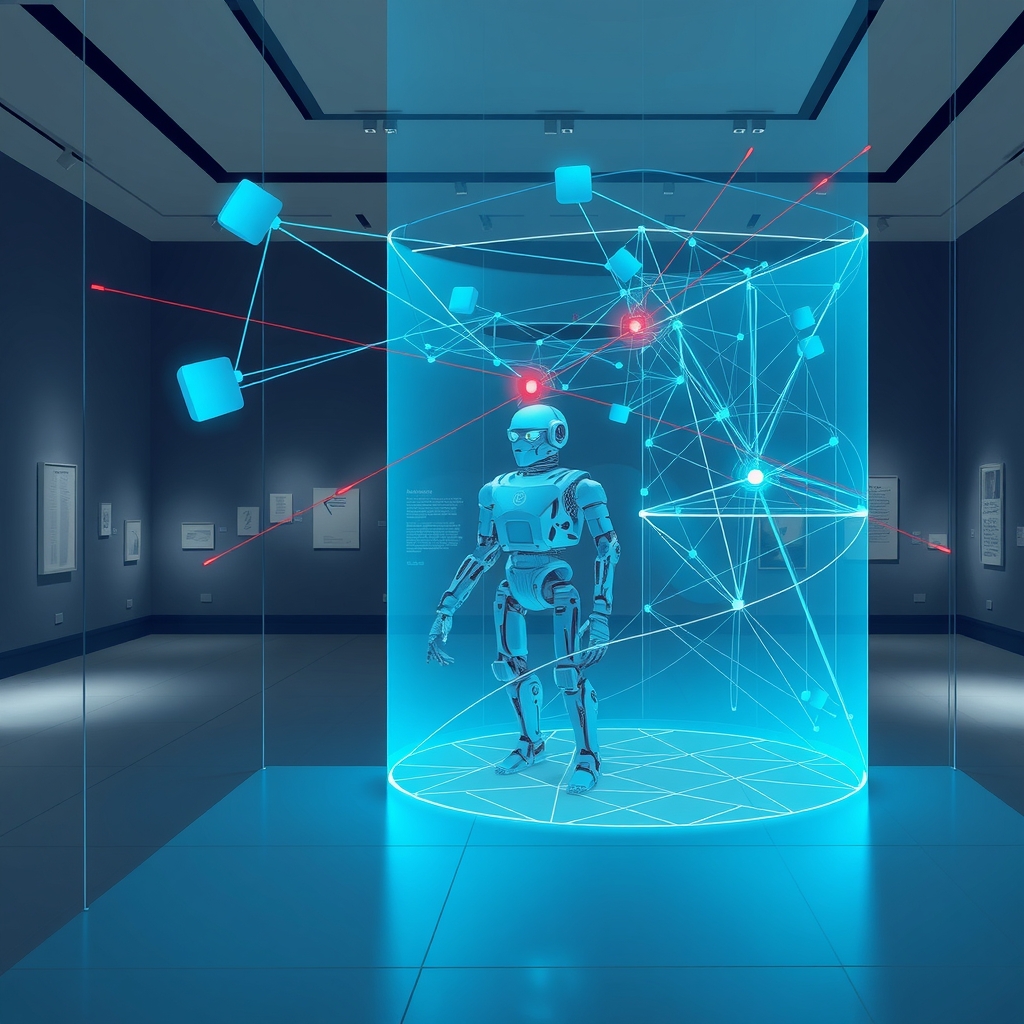
RHINO-AR uses Magic Leap 2 AR to overlay LiDAR, path-planning and traversability visuals onto RHINO, a landmark 1997 museum tour robot, now a static e
Main Story
In 1997, a wheeled mobile robot called RHINO made history at the Deutsches Museum Bonn. Deployed as an autonomous tour-guide, RHINO guided more than 2,000 visitors over six days, demonstrating robust autonomous navigation, obstacle avoidance, and interactive tour guidance in a live museum environment. Its deployment was one of the earliest successful examples of long-term autonomous robot operation in a public space and inspired later systems such as MINERVA. MINERVA, RHINO's successor, was subsequently deployed for two weeks in the Smithsonian's National Museum of American History.
Today, however, RHINO is behind glass — a static artefact. While the physical exhibit preserves the historical robot, it cannot convey the autonomous behavior that made RHINO important for visitors in the first place. That gap in understanding is precisely the problem a team at the University of Bonn's Humanoid Robots Lab has set out to close.
The team presents RHINO-AR, an interactive Augmented Reality (AR) museum exhibit that reintroduces the historical mobile robot RHINO into its original exhibition environment at the Deutsches Museum Bonn. The project builds on a lineage of immersive education tools from the same lab. RHINO-AR's predecessor, RHINO-VR, reconstructed the robot and the environment in virtual reality — an engaging experience that nonetheless separated visitors from the real exhibition space and from the physical robot on display.
RHINO-AR addresses this reality gap by placing a virtual reconstruction of the robot directly into the real museum space. The distinction matters: rather than transporting a visitor into a simulated world, AR preserves the physical context of the museum gallery while layering otherwise invisible processes on top of it. The exhibit's design philosophy — grounding abstract computational concepts in a concrete physical setting — reflects a broader challenge in robotics communication: key technologies such as localization, path planning, and obstacle avoidance remain difficult to understand for non-experts, and autonomous robots are often perceived as unpredictable "black boxes," potentially making public acceptance more difficult.
The research is authored by Nils Dengler, Tim Graf, Leif Van Holland, Patrick Stotko, Reinhard Klein, and Maren Bennewitz. All authors are affiliated with the Humanoid Robots Lab at the University of Bonn, with Bennewitz, Klein, and Dengler additionally associated with the Lamarr Institute for Machine Learning and Artificial Intelligence and the Center for Robotics, Bonn. The work was partially funded by the German Federal Ministry of Research, Technology and Space (BMFTR) under the Robotics Institute Germany (RIG).
Technical Breakdown
Platform / AR Hardware: Magic Leap 2 enterprise-grade optical see-through headset.
Software Stack: RHINO-AR is realized in Unity 6 and built around the Niantic Lightship Augmented Reality Developer Kit (ARDK), running on a Magic Leap 2 headset.
Environment Meshing: The team evaluated multiple meshing approaches before settling on their final pipeline. They compared the Magic Leap 2's native meshing system and an earlier integration relying on time-of-flight depth sensing against the Niantic Lightship ARDK. The depth-based variants produce more accurate geometry but update too slowly to keep pace with a freely walking user and passing visitors, and are more restrictive with respect to lighting conditions. The team therefore trades geometric accuracy for update rate, building on the Lightship ARDK, since in a crowded exhibition rapid adaptation to a changing scene matters more than maximum mesh fidelity.
Navigation Planning: For navigation, the system converts the reconstructed surface into Unity's NavMesh representation, on which a navigation agent plans the robot's motion using the A* algorithm.
Interactive Visualizations: The system combines real-time environment meshing with interactive visualizations of LiDAR sensing, traversability, and path planning to make otherwise invisible robotics processes understandable to non-expert visitors. Specifically, visitors can visualize the robot's path (rendered in blue), its laser sensing (red), and a navigation goal they interactively specify (purple).
Autonomy Level: The virtual RHINO reconstruction operates as a fully autonomous navigation agent within the AR scene, demonstrating sensing-to-planning pipelines without any manual teleoperation by museum staff.
User Study: The system was evaluated in a two-day museum study with 22 participants, assessing usability, technical performance, satisfaction, conceptual understanding, and preference compared to RHINO-VR. The user study indicates that RHINO-AR is well suited for the museum setting, with participants rating the system positively with respect to usability, technical performance, and overall satisfaction; results from understanding questions suggest the exhibit effectively conveys central concepts of autonomous mobile robotics. Overall, RHINO-AR was generally preferred over the VR exhibit due to its stronger physical grounding and increased realism.
Industry Impact
For AR Hardware Manufacturers: The RHINO-AR project offers a substantive public-sector validation case for enterprise AR headsets such as the Magic Leap 2. The Magic Leap 2 is an immersive AR headset built for enterprise solutions that allows seamless blending of the physical world with the digital world, and is used across multiple industries for training, collaboration, remote support, and visualization. Museum education deployments could become a significant, recurring market segment as cultural institutions look to modernise static exhibits.
For Robotics Educators and Science Communicators: The RHINO-AR architecture — anchoring a simulated autonomous agent to a physical artefact and visualising its internal decision-making in real time — offers a replicable template. Sensing pipelines (LiDAR sweeps), traversability maps, and A*-planned paths are all concepts that appear in modern UAV ground-control and autonomy stacks; making them legible to non-expert publics has direct relevance to social license for autonomous aerial systems as well.
For Museum and Cultural Institutions: The project demonstrates that AR can extend the communicative reach of a static exhibit without physically modifying it. The key design lesson from the RHINO-VR-to-RHINO-AR transition — that spatial grounding in the real environment significantly improves user preference and conceptual uptake — is actionable guidance for institutions planning immersive technology investments.
For Autonomy and AI Researchers: RHINO-AR preserves the physical context of the exhibit while making otherwise invisible robotics processes such as sensing, traversability estimation, and path planning visible to visitors in an intuitive way, setting a methodological benchmark for how AR can serve as an explainability interface for autonomous systems — a challenge that extends well beyond museum settings into operational environments where human-robot trust must be established rapidly.