
Anduril Brings The Thunder With Autonomous Tiltrotor Attack Drone Concept
Anduril and Archer unveil Thunder, a Group 5 autonomous hybrid-electric tiltrotor designed to team with AH-64 Apaches and MV-75 Cheyennes at low altit
Main Story
On July 20, 2026 — the opening day of the Farnborough International Airshow — Anduril Industries and Archer Aviation jointly unveiled Thunder, a fully autonomous, hybrid-electric tiltrotor combat drone conceived as a loyal wingman for crewed rotary-wing attack aircraft. The reveal marks Anduril's clearest move yet into Army aviation, applying the crewed-uncrewed teaming (CUT) logic it has already demonstrated in the fixed-wing domain with its YFQ-44A Fury Collaborative Combat Aircraft — now in serial production at its Arsenal-1 factory in Ohio — to the more tactically complex near-surface rotorcraft environment.
Anduril has revealed a new hybrid-electric-powered tiltrotor combat drone called Thunder, developed in partnership with Archer Aviation, envisioned as a highly autonomous pilotless wingman able to fly fast and low in formation with crewed helicopters and tiltrotors like the AH-64 Apache and MV-75 Cheyenne II.
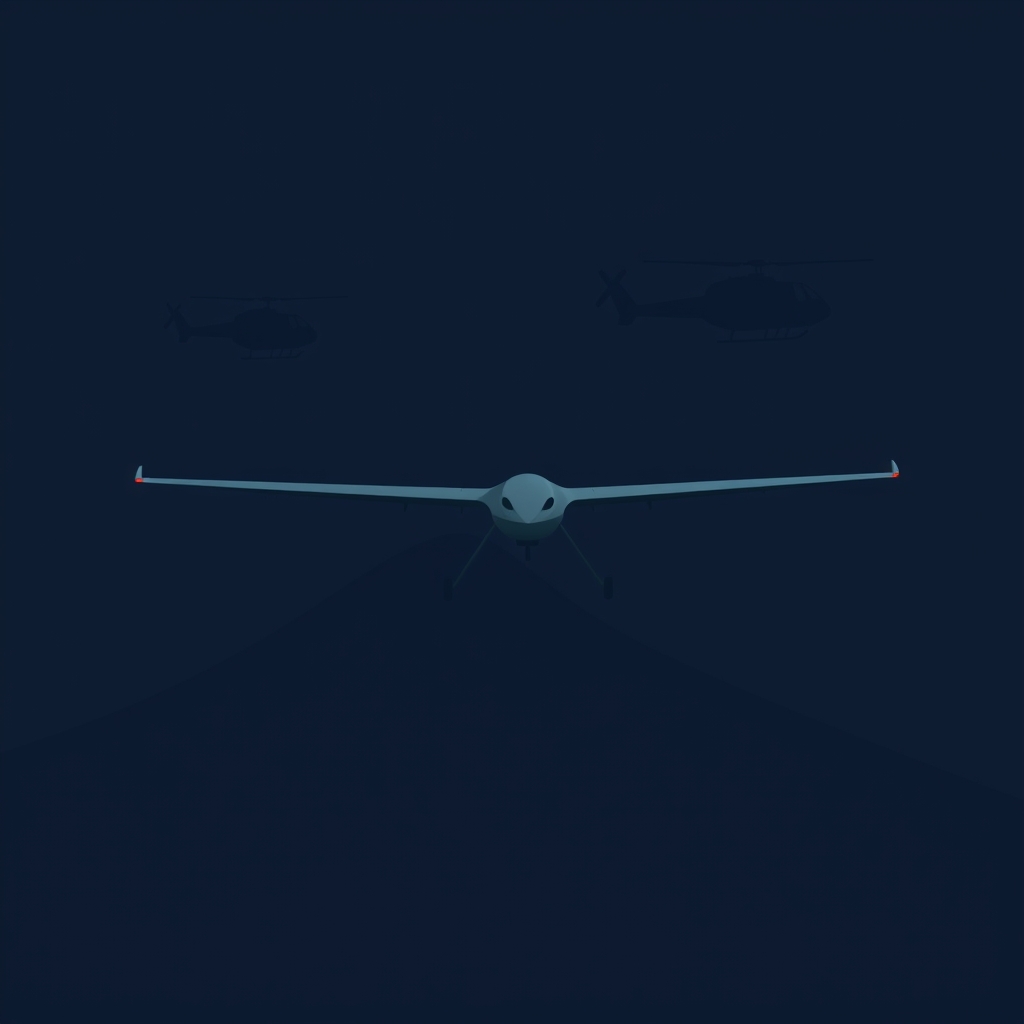
Thunder is a Group 5 unmanned tiltrotor helicopter that can function as a loyal wingman drone much like the Collaborative Combat Aircraft being developed for fighter jets. The core operational concept is straightforward: keep human crews further from the most dangerous parts of a sortie while multiplying available sensors and munitions. The drones could help hunt down targets, including fleeting ones, while allowing their human teammates to stay further away from threats. Thunder is also being designed to help provide an extra layer of close-in defense for friendly rotorcraft, including against the growing threat of air-to-air drone attacks.
The platform has been approximately three years in development. Anduril President Chris Brose said Thunder is a fully autonomous, armed reconnaissance tiltrotor aircraft developed from lessons learned from the company's fixed-wing YFQ-44A — the Fury aircraft — that is currently being produced for the Air Force's Collaborative Combat Aircraft effort. The technological lineage is not purely from the fixed-wing domain, however. The Thunder design combines the optimum-speed tiltrotor technology of Karem Aircraft, the hybrid-electric drivetrain of electric-VTOL aircraft developer Archer Aviation, and Anduril's own autonomous control system. Archer separately announced an exclusive partnership in December 2025 with Karem Aircraft, a rotorcraft company whose tiltrotor technology has already been evaluated by the U.S. Army, giving the joint Thunder program access to military-validated rotor and tiltrotor engineering.
The industrial logic underpinning the design is explicit: bridge the commercial eVTOL supply chain into defence procurement. Arnott said Thunder reuses technology from Archer's Midnight eVTOL aircraft, adapted with a hybrid-electric powertrain to extend range, allowing Anduril to draw down production lines and supply chain investment that Archer has already built up in the commercial eVTOL sector. The intent is to bring the unit cost of Thunder down to a small fraction of that of Apache, enabling the aircraft to be fielded at scale.
Anduril describes the formation concept as three to six Thunders operating alongside a single crewed platform. "We can have three to six of these things flying with an Apache to provide that loyal wingman nature, and doing so in a sense that is commanding and not controlling these systems," Arnott said. The company frames the mass-multiplication arithmetic in stark terms: "By teaming three Thunder aircraft with each Apache, for example, a Combat Aviation Brigade will achieve a three times increase in available munitions without placing additional pilots in harm's way, all at a fraction of the cost of a similarly-sized formation of exclusively crewed aircraft," Anduril said in a statement.
The design's operational doctrine is driven directly by the rising lethality of the low-altitude environment. Man-portable air defence systems, loitering munitions and low-cost air defence capabilities have all increased the risk to crewed attack aviation. Arnott has pointed to Thunder's Optimum-Speed Tiltrotor (OSTR) technology as a key survivability feature: the OSTR technology gives Thunder an acoustic signature that is a fraction of the Apache's, reducing its vulnerability to man-portable air defence systems.
The target customer base extends well beyond the U.S. Army. Anduril has developed the drone with eyes on future Army, Marine Corps, and U.S. Special Operations Command missions. Internationally, Thunder's design appears to align with Project NYX, a British pursuit of autonomous wingmen for Boeing-made Apache helicopters, and Anduril was one of four companies shortlisted for NYX in May. Anduril has declined to formally link the Thunder launch to the NYX competition, but the timing of the Farnborough debut is unmistakably deliberate.
At the time of writing, Anduril has released only relatively broad details about Thunder's expected performance and specifications. A first flight is currently targeted for some time next year, and full-scale production could be underway by the end of the decade, depending on demand. The company said it is initially sizing production facilities for around 50 aircraft annually, with scope for further expansion if required.
Technical Breakdown
UAV Class: Group 5 (maximum takeoff weight ≥ 1,320 lb / 599 kg; capable of operating above 18,000 ft). Anduril describes Thunder as a Group 5 design. The U.S. government's Group 5 is the highest tier, covering anything with a maximum takeoff weight of 1,320 pounds or more that can fly at altitudes of 18,000 feet or higher.
Platform Configuration: Thunder is a clean-sheet design with a relatively traditional tiltrotor layout featuring a high-mounted, straight main wing on top of the fuselage, with a single tilting rotor pod at each tip. It also incorporates a V-tail. The tiltrotor configuration enables both vertical takeoff and efficient wingborne cruise. The platform's tiltrotor configuration combines vertical takeoff and landing with efficient wingborne cruise, enabling runway-independent operations from austere locations without the range constraints of traditional rotorcraft.
Propulsion: A series hybrid-electric powertrain enables Thunder to achieve significant range and endurance while maintaining the necessary precision to closely optimize power through the full range of flight conditions. The dual tiltrotors vary rotor RPM to maintain efficiency across flight regimes, reducing power demand and fuel burn in cruise and minimizing acoustic signature to enhance survivability during low-altitude ingress. Specifically, with stiff composite blades and rigid hubs, the electrically actuated proprotors can reduce their rotational speed by up to 50%, providing maximum thrust in hover and the ability to rotate slower for greater efficiency during cruise flight.
Speed and Range: Thunder is intended to cruise at speeds in excess of 200 knots — considerably faster than the Apache — with a range extending to thousands of nautical miles, sufficient for operations across the Pacific or in NATO's High North. Arnott explicitly benchmarked it against the MV-75 Cheyenne II: "This has the range of a Cheyenne, has the speed of a Cheyenne, but the payload equivalency of the Apache."
Payload: The aircraft has two configurable payload bays that can carry a range of munitions, such as the AGM-114 Hellfire missile, Advanced Precision Kill Weapon System (APKWS) kits, or the Army's launched effects. In terms of maximum capacity, the main payload bay can carry up to 10 Hellfires, 16 air-launched effects, or 76 rockets. The nose bay is configured for counter-UAS systems that provide protection both to Thunders and to any crewed aircraft flying with them.
Sensors: In addition to weapons in the internal fuselage bay, Thunder features payload bays in the nose and aft for an array of sensors, which could include passive systems for detecting air-to-air attack drones and other threats at low altitude.
Altitude and Flight Profile: "It will have the ability to work at 18,000 feet, but the intent is for it to be nap-of-the-earth for most of its life," according to Arnott.
Autonomy: Arnott said the drone is powered by "all the advanced software and AI-enabled work that Lattice makes possible," referring to Anduril's software platform designed to collect and combine information from separate sensors and systems to create a comprehensive operational picture. Autonomy software development has been ongoing for approximately two years and has already been validated on surrogate aircraft. The engineering challenge Arnott emphasised was not the physical airframe but getting the autonomous system to fly fast and low without intersecting with terrain while dealing with rapidly emerging threats — work conducted using technologies coming out of the self-driving car industry.
Transportability: Thunder is described as smaller than the Apache and transportable inside a standard 40-foot shipping container, requiring separation of the wing structure from the fuselage for loading. The drone will also have the speed and range for self-deployment.
Development Timeline: Programme has been underway approximately three years. Anduril has been testing the autonomy software for two years; the company plans to start flight testing the UAS in 2027. If demand materialises, Anduril could start building Thunder by the end of the decade, with rate production targeted in the 2029–2030 timeframe.
Industry Impact
For Army Aviation Modernisation: Thunder enters a gap created by the retirement of the Bell OH-58D Kiowa Warrior and the cancellation of the Future Attack Reconnaissance Aircraft (FARA) programme. Anduril's concept signals that it believes the Army should move beyond its current approach of using a subset of the MQ-1C Gray Eagle fleet — a fixed-wing, turboshaft-powered Predator derivative — to fill the armed scout role. The Army is also actively searching for a Group 4+ S/VTOL UAS to replace the MQ-1C; the Thunder reveal coincides with the Army's search for an armed VTOL or STOL aircraft, following an industry day in March for a Group 4+ S/VTOL UAS.
For Anduril: Thunder represents a significant broadening of Anduril's autonomous airpower portfolio beyond fixed-wing domains. Just one month prior to the Farnborough reveal, the Air Force announced it would take the Fury (YFQ-44A) into production — giving Anduril simultaneous loyal wingman programmes for both Air Force fixed-wing CCA and Army rotary-wing missions. The dual-use platform structure, with Archer selling a commercial VTOL variant, also gives the programme a civilian revenue base that could help subsidise defence unit costs and sustain the supply chain.
For Archer Aviation: Anduril developed Thunder alongside Archer Aviation, which specialises in electric vertical takeoff and landing aircraft. The partnership gives Archer a defence anchor programme for technology it has developed for commercial air taxi operations, with military qualification potentially de-risking the commercial variant's certification path.
For Operators and Integrators: Thunder's autonomy package is specifically designed to fly at high speeds in low-altitude environments with crowded terrain, obstacles, and threats; it is designed to maneuver with manned and unmanned platforms and share real-time data. Operators face a new integration task: embedding a "commanding, not controlling" teaming model into existing Combat Aviation Brigade doctrine and mission planning workflows.
For International Markets and Competitors: Anduril declined to disclose the identity of current government customers, though Arnott confirmed government customers were already involved, and stated the intended customer base extends to any operator of reconnaissance or attack helicopters. Boeing previously unveiled its own tiltrotor drone wingman concept at the 2025 Association of the U.S. Army conference, drawing on lessons from its MQ-28A Ghost Bat programme, establishing that Thunder will face competition in this emerging market segment.
For Regulators and Standards Bodies: The concept of autonomous Group 5 rotorcraft operating in formation with crewed aircraft at nap-of-the-earth altitudes presents novel airspace deconfliction and certification challenges that existing regulatory frameworks — built around remotely piloted systems operating in segregated airspace — do not yet address. As programmes like Thunder, the CCA fleet, and international equivalents approach first flight, regulators and standards bodies will face pressure to develop crewed-uncrewed teaming airspace rules for contested and training environments alike.