
Marines Want Their Own Drone Boats: How a Combat Deployment Exposed the USMC's USV Gap
A 31st MEU combat commander wants Marine-organic drone boats. What the USV capability gap means for amphibious ops and the industry racing to fill it.
Main Story
The officer who led one of the U.S. Marine Corps' most consequential recent combat deployments has a clear message for the service: drone boats need to be a Marine asset, not just a Navy one.
Colonel Chris P. Niedziocha commanded the 31st Marine Expeditionary Unit during its deployment to the Middle East in support of Operation Epic Fury. Now serving as director of the USMC Expeditionary Warfare School, Niedziocha spoke candidly about capability gaps identified during that deployment.
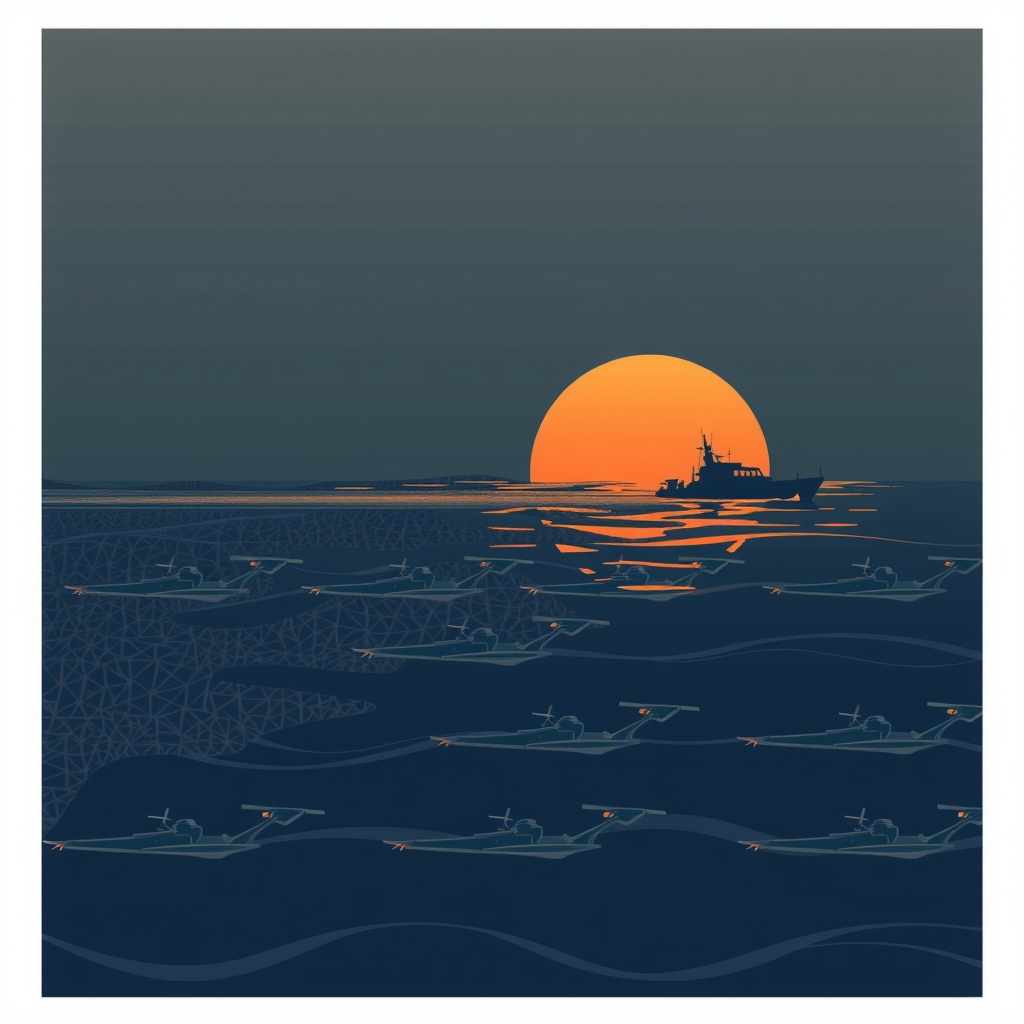
The colonel told The War Zone that he needs his own uncrewed surface vessels (USVs) on future deployments. Operationalising USVs is an area where the Marines are lagging behind — and in particular, Niedziocha wants the ability to send USVs forward to reconnoitre potential highly-contested beach landing areas, a mission that has largely been assumed by the Navy.
During the deployment, the 31st MEU was embarked aboard the Tripoli Amphibious Ready Group, which consisted of the America-class amphibious assault ship USS Tripoli, San Antonio-class amphibious transport dock ship USS New Orleans, and Whidbey Island-class dock landing ship USS Rushmore. Throughout the deployment, the Tripoli ARG and 31st MEU conducted over 1,600 mishap-free flight hours of combat aviation missions, transporting 800,000 pounds of cargo and moving 5,000 personnel.
Marines conducted four maritime interdiction operations, three of which culminated in boardings. The colonel noted that the 31st MEU observed the full range of adversary capabilities including surveillance and reconnaissance assets, one-way attack drones, and short- and medium-range ballistic missiles.
The broader context for Niedziocha's demand is that combat-proven USVs were already operating in the same theatre — just not under Marine Corps command. Pentagon spokesperson Tim Hawkins confirmed that unmanned vessels built by Maryland-based BlackSea Technologies — the Global Autonomous Reconnaissance Craft, or GARC — were used for patrols as part of Operation Epic Fury, logging over 450 underway hours and more than 2,200 nautical miles during maritime patrols.
The U.S. has for years been trying to build a fleet of autonomous uncrewed surface and underwater vessels as a cheaper and faster alternative to manned ships and submarines, but the effort has fallen behind schedule and been dogged by technical problems, cost concerns, and testing setbacks. Last year, the GARC was involved in multiple performance and safety issues, including a collision with another boat at speed during a military test, and during a recent failed test in the Middle East, one GARC became inoperable.
Despite those growing pains, the case for Marine-organic USVs is gaining institutional weight. In late August at Camp Pendleton, the PM CSS Explosive Hazard Defeat Team tested an unmanned surface vessel in response to a littoral capability gap, and while Colonel Niedziocha did not address USVs for offensive combat roles, the Marines have evaluated them for that use as well as for logistics, among other functions.
Separately, the U.S. Marine Corps has tested an unmanned surface vessel designed to detect and investigate explosive threats across contested littoral zones, as part of the Littoral Explosive Ordnance Neutralization (LEON) system, which aims to keep explosive ordnance disposal teams farther from mines and other hazards that could block amphibious access. LEON combines surface, underwater, ground, and diver-operated capabilities to locate, confirm, and mark explosive hazards from shallow water through the beach zone.
The Leidos logistics USV programme adds another dimension. The U.S. Marine Corps is deploying unmanned surface vessels to Japan to streamline logistics across the Indo-Pacific region. Built by Leidos, the USVs include the Autonomous Low-Profile Vessel (ALPV), also known as Sea Specter — featuring a low-profile design for stealthy operations — and the Small Unmanned Surface Vehicle (SUAV), known as Sea Archer, built for high-speed manoeuvring. The Sea Specter is already supporting early operations with the U.S. Marine Corps in the Indo-Pacific, with one deployed in the Pacific and another in the Atlantic.
At the Navy level, ambitions are accelerating fast. The U.S. Navy is looking to field thousands of unmanned surface vessels to the Indo-Pacific by 2030. "By 2030, expect to see over 30 Medium Unmanned Surface Vessels just in the Indo-Pacific. Expect to see thousands of small USVs," said Captain Garrett Miller, commander of Surface Development Group One.
But the colonel's demand cuts to a structural question the numbers alone don't answer: who controls the forward USV? For amphibious operations, Niedziocha's position is that the Marine ground commander needs organic control of the unmanned surface layer — not a shared asset managed by the Navy, arrived at through a joint request process. Augmenting the surface fleet with a large volume of low-cost USVs could save lives and make logistical support more efficient; such vessels would be harder to detect and less worthwhile to engage with expensive weaponry, and would connect Marines operating from forward positions to valuable supplies while reducing risk to manned surface vessels.
Technical Breakdown
Platform in combat theatre: GARC (Global Autonomous Reconnaissance Craft)
- Developer: BlackSea Technologies, Baltimore, MD
- Class: Small Unmanned Surface Vessel (sUSV)
- Powered by a 200-hp diesel engine, the 15'8" × 5'8" GARC reaches speeds up to 40 knots with a range exceeding 680 nautical miles.
- Payload capacity: up to 1,000 pounds; range: 700 nautical miles at 22-knot cruise speed.
- Performance envelope: 22 knots cruise, 40-knot sprint, up to 700 nautical miles at cruise or 1,600 nautical miles at 5 knots; rated for operation in Sea State 5.
- With over 5,000 operational hours in U.S. Navy Fleet operations, GARC has proven its reliability in conditions including up to 15-foot seas.
- Its control architecture supports both autonomous and remote operations with seamless integration of third-party tools; designed to support a wide range of missions including ISR, communications relay, and mine countermeasures.
- The GARC features a removable centre panel to allow for rapid integration of mission-specific payloads.
- GARC is built on an active production line at the former Bethlehem-Fairfield Shipyard in Baltimore, currently delivering a completed unit every day.
Marine Corps logistics USVs (Leidos programme)
- The Sea Specter (ALPV) features a low-profile, narco-sub-inspired design for stealthy operations; the Sea Archer (SUAV) is built for high-speed manoeuvring.
- Sea Archer has completed all builder's trials and is in late-stage testing of its autonomous systems; the company plans to test an upgraded payload module for enhanced mission capability.
LEON USV (Mine/EOD role)
- A commercial unmanned surface vessel fitted with sonar, forward-looking infrared cameras, and both line-of-sight and acoustic communications gear; capable of driving itself along pre-programmed routes.
- The LEON System of Systems consists of five capability increments: a Remotely Operated Vehicle, diver equipment, an Unmanned Underwater Vehicle, an Unmanned Surface Vehicle, and an Amphibious Unmanned Ground Vehicle.
Industry Impact
For manufacturers: Driven by battlefield lessons from Ukraine and growing competition with peer adversaries, the U.S. Navy is accelerating plans to deploy small, medium, and large uncrewed surface vessels, prompting rapid response from the maritime industrial base. Niedziocha's public demand for Marine-organic USVs opens a distinct, additive procurement channel beyond existing Navy programmes — a potential expansion of the addressable market for platforms like the GARC, Sea Specter, and Sea Archer.
For operators and integrators: Unmanned logistics could reduce demand on amphibious ships significantly in distributed scenarios, freeing those hulls for higher-priority missions. Earlier experiments scaled from the 12-foot MANTAS to the 38-foot Devil Ray, which can carry 4,000 pounds of supplies — but even such efforts cannot provide the sheer volume of logistics sustainment Marines need to push inland beyond the beach. Medium and large USV integrators are therefore well-positioned as the next phase of Marine Corps procurement matures.
For regulators and standards bodies: The LEON programme's September 2026 testing milestone, combined with the DIU's active Autonomous Low-Profile Vessel solicitation, signals that the Marine Corps is moving from proof-of-concept exercises toward structured acquisition. In September 2025, the Secretary of the Navy established dedicated Programme Executive Office, Portfolio Acquisition Executive, and Deputy Assistant Secretary positions specifically for Robotic and Autonomous Systems, signalling institutional commitment to the procurement and deployment of unmanned maritime systems.
For investors: The GARC programme hit turbulence — collision and software issues during testing, operational reliability concerns, and setbacks in autonomous software integration — making combat patrols under Operation Epic Fury a real-world validation attempt after a difficult test cycle. Investor scrutiny of USV programmes should weigh demonstrated operational hours and production rates (the GARC's daily production cadence and 5,000+ logged fleet hours) against unresolved software maturation challenges. The Marine Corps' parallel multi-vendor approach — Leidos for logistics, BlackSea for ISR/patrol, and a commercial integrator for LEON — also suggests a diversified procurement posture rather than a single-winner market.