
Drones, Satellites, and Common Controls: How Cross-Domain Connectivity Is Rebuilding ISR from the Ground Up
How drones, satellites, and unified control software are reshaping ISR resilience across contested multi-domain environments in 2026.
Main Story
The core logic of Intelligence, Surveillance, and Reconnaissance has not changed: commanders need a clear, continuous picture of the battlespace. What has changed is everything underneath that logic — the platforms, the data pipes, the control architectures, and the threat environment those systems must survive in.
ISR is collected across an expanding array of vectors. Whether gathered by drones, manned military aircraft, or modified civilian platforms, the raw material of battlefield awareness is now generated at a scale and from a diversity of sources that earlier generations of C2 architecture were never designed to handle. The challenge in 2026 is no longer collection. It is connectivity, resilience, and control.
The Interoperability Problem at the Edge
One of the most persistent friction points in multi-platform ISR is the fragmentation of ground control. Lessons from the US military's Replicator drone initiative revealed a structural flaw: while the programme successfully procured large numbers of attritable commercial airframes, it failed to anticipate the systems engineering challenges of integrating those platforms with existing joint command-and-control (C2) software architectures. Many commercial systems lacked the open APIs necessary to communicate with military battle management networks, forcing operators to run separate, non-interoperable control stations for different drone models — a condition that directly degraded operational tempo.
The Marine Corps is addressing this head-on. At the 2026 Modern Day Marine Conference, Marine Corps Major Michael Zbonack stated that the service is working with industry to develop a common controller software solution that enables troops to hand off drone control as needed, as part of a broader push to field the Corps' own organic ISR drone capability rather than relying on contractors.
The architecture problem extends beyond software. In a contested environment, the real challenge is not simply gaining connectivity — it is sustaining trusted, prioritised, and secure connectivity when links degrade, become congested, or come under electronic attack. Military networks now span Low Earth Orbit (LEO), Medium Earth Orbit (MEO), and Geostationary (GEO) satellite systems simultaneously, alongside terrestrial and tactical RF links — a topology that demands intelligent, dynamic routing rather than static pipelines.
Spectrum resilience is now treated as a first-order operational capability, on par with kinetic systems. Solutions such as cognitive software-defined radios and dual-waveform tactical networking have emerged to maintain reliable communications in electronically contested environments. The underlying goal is to preserve decision-quality data flow for the traffic that matters most, even as links degrade.
The Air Force Reshapes Its Drone Fleet
The Air Force's response to the survivability problem in contested airspace is the Massed Modular Aircraft (MMA) programme, a joint effort with the Defense Innovation Unit (DIU) announced in July 2026. The programme's purpose is to field a low-cost, semi-autonomous UAS capable of performing the combined ISR and strike missions currently carried out by the MQ-9A Reaper — at a price point and at a scale that makes attrition operationally acceptable.
At the 2026 AFA Air, Space & Cyber Conference, Air Force Secretary Troy Meink set a revised and significantly more ambitious fielding goal: 100 MMA drones by 2029 and 500 by 2032. The target airframe-only unit cost is set at no more than $10 million — roughly half the cost of a Collaborative Combat Aircraft (CCA) and one-tenth the cost of a fifth-generation manned fighter. A production commitment of 500 units at that price represents a potential expenditure of approximately $5 billion on production aircraft alone, before sensors or mission systems are factored in.
The MMA is envisioned as a modular platform: the airframe provides a baseline capability, with sensors, payloads, and mission systems added or swapped depending on the sortie. General Atomics Aeronautical Systems (GA-ASI) has publicly revealed its Wildfire candidate, described as a clean-sheet design built to exceed the Air Force and DIU's ferry range requirement of 8,000 nautical miles. Wildfire is designed to be modular, allowing the Air Force to rapidly reconfigure payload packages. Anduril has also signalled interest in competing for the MMA requirement.
The programme's acceleration was driven in part by operational experience. The MQ-9A Reaper was designed for permissive airspace environments — it is a slow, non-stealthy platform with a long loiter time. Against an adversary with functioning layered air defences, those characteristics make it a target. The Air Force's answer is to shift toward lower-cost, attritable platforms that can be fielded in sufficient numbers to absorb losses and overwhelm enemy air defence systems through mass.
Space-Based ISR and the Orbital Layer
Beyond the atmospheric domain, space-based ISR is becoming a foundational — and increasingly contested — layer of the multi-domain picture. US Space Force Delta 7, headquartered at Peterson Space Force Base, Colorado, is the operational ISR and Targeting element of the Space Force, providing time-sensitive intelligence for space domain operations including detection, characterisation, and targeting of adversary space capabilities. The unit now encompasses six ISR squadrons — the 71st through 76th ISRS — having doubled its combat power in recent years, and employs a variety of fixed and mobile sensors globally. Delta 7 was designated the 18th member of the US Intelligence Community in January 2021.
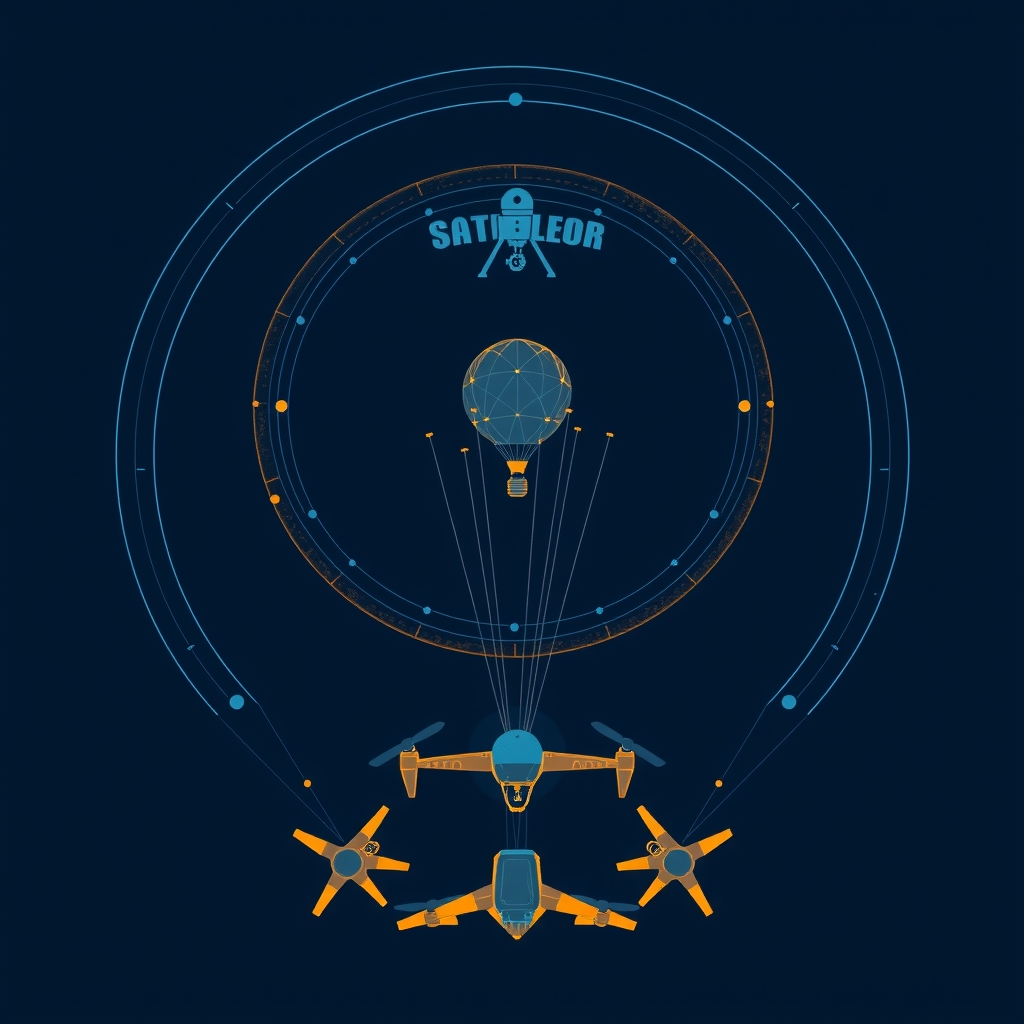
The integration of satellite-derived ISR with tactical drone data is an active area of development. European efforts are already underway to fuse satellite and drone data streams into unified ISR mission software, with the goal of providing defence users with synchronised, multi-domain intelligence spanning space-based collection and tactical drone operations. In the commercial and defence-industrial space, partnerships such as the one between Palantir Technologies, Ondas, and World View Enterprises are building AI-enabled operational architectures that connect stratospheric, aerial, and land-based systems into a single command-and-control network — with World View's stratospheric Stratollite balloon platform bridging the coverage gap between satellites and conventional aircraft.
From Data Visibility to Decision Advantage
The deeper challenge across all of these initiatives is not collection volume — it is converting fragmented, multi-source sensor data into timely, trusted decisions. Defence organisations are generating more sensor data than ever, but in contested environments, value comes from turning fragmented signals into actionable intelligence faster than an adversary can degrade or disrupt the network. Unified ISR networks that connect separated platforms, sensors, and command nodes — enabling a common operational picture — are the enabling layer for the AI-infused decision cycles that modern operational tempo demands.
The need to operate effectively in contested electromagnetic and cyber environments is now directly influencing platform design choices, payload integration priorities, data security requirements, and communications architecture from the ground up.
Technical Breakdown
Platform classes covered:
- Massed Modular Aircraft (MMA): Semi-autonomous, fixed-wing UAS; air vehicle target cost ≤$10M (airframe only); ferry range requirement ≥8,000 nautical miles; modular payload architecture for sensor/mission-system swaps; designed for attritable mass employment. Intended to replace the MQ-9A Reaper in ISR and strike roles.
- MQ-9A Reaper (legacy ISR platform): Full system cost ~$50M; non-stealthy; long loiter time; originally designed for permissive airspace.
- GA-ASI Wildfire (MMA candidate): Clean-sheet design; stated to exceed 8,000 nm ferry range; modular configuration; baseline sensing capabilities with open payload architecture.
- Stratollite (World View): Stratospheric balloon platform; persistent long-duration ISR at reduced cost; altitude enables sensing above controlled airspace; EO/IR and environmental monitoring payloads.
- Tactical UAS (Marine Corps / organic ISR fleets): Requiring common controller software enabling drone hand-off between operators.
Autonomy level: MMA targets semi-autonomous operation with the capability to operate in groups to overwhelm adversary air defences. Edge ISR architectures are incorporating onboard AI processing for autonomous target recognition and low-probability-of-detection data link dissemination.
Command and control: Common controller software (Marine Corps development path); open-API integration with joint battle management systems; AI-enabled multi-domain C2 platforms (Palantir AIP-based architecture in commercial/defence partnerships).
Communications resilience: Cognitive software-defined radios; dual-waveform tactical networking; multi-orbit SATCOM (LEO/MEO/GEO) with dynamic routing; transport-aware optimisation including TCP acceleration, forward error correction, and header compression for degraded-link conditions.
Space layer: Space Delta 7 — six ISR squadrons; fixed and mobile sensor network globally; targeting, threat analysis, and processing/exploitation/dissemination mission sets.
Industry Impact
Manufacturers: The MMA programme opens a significant new competition for attritable UAS platforms, with GA-ASI (Wildfire) and Anduril already publicly positioning. The multi-vendor model — similar to the CCA programme — signals that the Air Force is deliberately avoiding single-source dependency. At a ≤$10M airframe unit cost and a stated 500-unit procurement goal, production economics will heavily favour manufacturers with efficient, scalable manufacturing and open-architecture integration frameworks. Modularity is a primary selection criterion, rewarding suppliers with flexible payload and sensor integration ecosystems.
Operators: The shift toward common controller software architectures directly addresses the operational bottleneck of managing heterogeneous drone fleets with siloed ground control stations. Services that achieve genuine interoperability — where any authorised operator can hand off control of any platform in the network — will gain significant advantages in operational tempo and mission flexibility in contested environments.
Regulators and standards bodies: The drive toward common APIs and open software architectures for drone C2 is creating pressure on interoperability standards. Programmes like MMA's DIU-led development model emphasise rapid prototyping and standards alignment, which may accelerate the adoption of open-systems architecture requirements in defence acquisition frameworks.
Investors: The multi-domain ISR integration market is attracting investment across the stack — from airframe manufacturers and payload suppliers to C2 software developers, AI analytics platforms, and communications resilience specialists. The convergence of stratospheric, orbital, and tactical UAS layers into unified data architectures represents a systems-integration opportunity that favours software-defined, platform-agnostic solution providers.
Integrators: The technical complexity of fusing data streams from orbital satellites, stratospheric persistent platforms, and tactical drone fleets — across contested electromagnetic environments — places a premium on systems integrators with cross-domain C2 expertise, secure data-link engineering, and AI-enabled analytics capability. The gap between data collection and decision-quality intelligence remains the key value-creation point in the ISR chain.