
Explosive Quadcopter at Leipzig: Germany Formally Attributes An-124 Drone Strike to Russia
Germany formally attributes the Aug 2026 explosive-drone strike on a Ukrainian An-124 at Leipzig/Halle Airport to Russian state actors — what the fore
Main Story
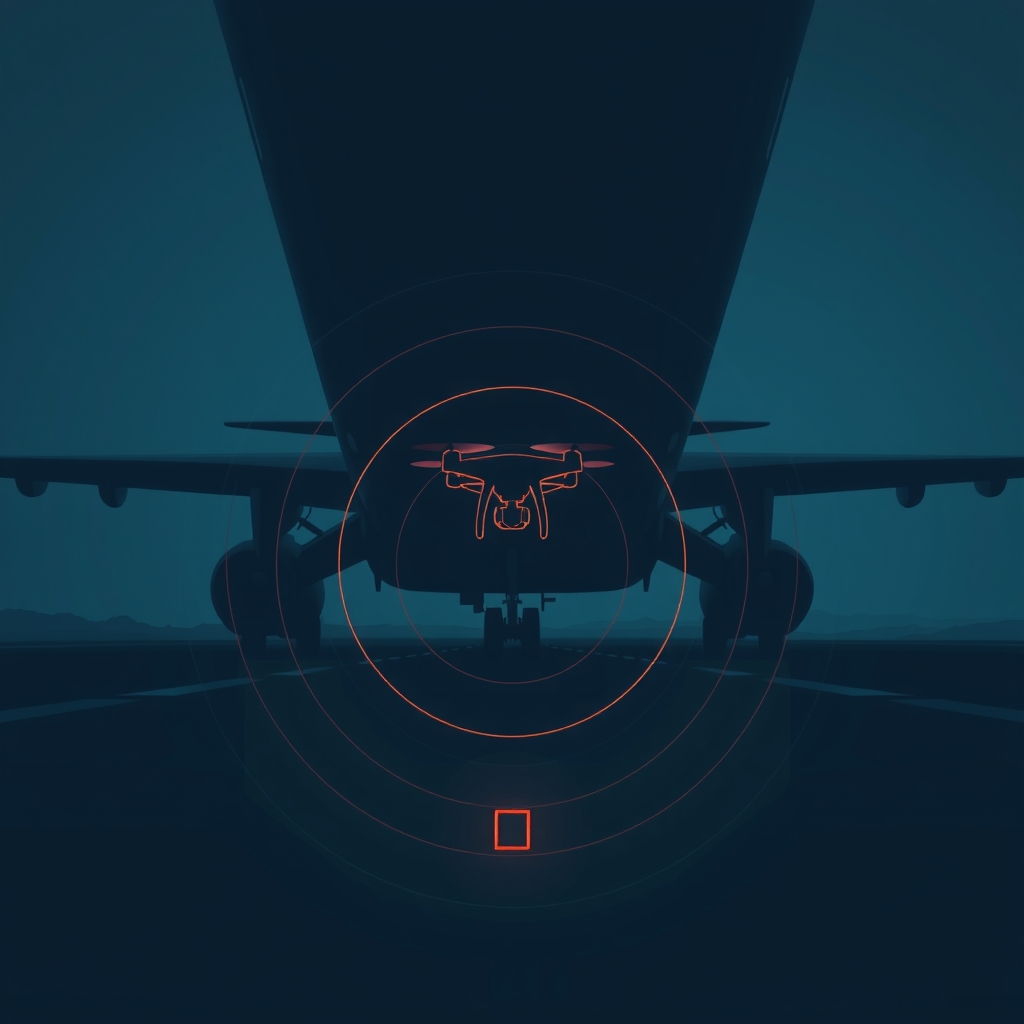
In the late evening of 4 August 2026, a small quadcopter drone crossed the perimeter fence of Leipzig/Halle Airport and flew directly toward a parked Ukrainian Antonov An-124 Ruslan heavy-lift freighter. Newly analyzed airport camera footage showed the quadcopter fly straight at the An-124 and strike its wing. The device bounced off the wing, fell to the ground, and failed to detonate.
The explosive payload was not trivial. The bomb contained the plastic explosives Semtex and PETN, with the recovered charge reportedly as much as 800 grams. The detonator failed — that failure is the only reason subsequent analysis was forensic rather than fatal, as the device sat a few meters from the parked freighter, unnoticed, for roughly four hours. According to reporting by Bild, the drone struck the An-124 close to the aircraft's fuel tank.
Special electronic countermeasure and drone detection systems installed on the airport grounds were unable to detect the aerial target in time. Federal Interior Minister Alexander Dobrindt assessed that the drone was probably modified deliberately to slip past the airport's protection systems. It was ultimately a bus driver, not any defensive system, who brought it to the attention of authorities.
Germany's federal prosecutor took the case over on 6 August, classifying it as an attack on transport infrastructure capable of endangering national security. Germany's National Security Council convened under Chancellor Friedrich Merz on 7 August.
The formal attribution came weeks later. Interior Minister Dobrindt told reporters that intelligence points to "people being involved who acted on behalf of Russian state entities," adding that "taken together, the police investigations, the pattern and intelligence findings prove a Russian responsibility for the attempted attack at Leipzig airport." Foreign Minister Johann Wadephul stated that "the methods used, including the drone's design, its components, the explosives, and the detonation systems, are known to us from other Russian hybrid operations and from Russia's war against Ukraine." Moscow has rejected the accusation.
US intelligence had reached a similar conclusion independently. US intelligence determined that Russian military intelligence was involved in the attempted act of sabotage. The explosives and drone design were assessed to match equipment used by Russia's Main Directorate of the General Staff.
Forensic work added another layer. Investigators secured DNA traces on the drone, and while no individual has been identified, there has been a match in the European DNA database with a trail apparently leading to Lithuania. The DNA also reportedly matches material from an arson attack on 20 July 2024 on the DHL logistics centre at Leipzig Airport. That 2024 DHL incident has since been tied by European investigators to the GRU, Russia's military intelligence service, through 22 identified suspects.
The Leipzig incident was not an isolated security event that day. In the eastern state of Brandenburg, authorities said the power grid was deliberately targeted with specially prepared incendiary devices and rockets carrying conductive material, targeting the Turnow-Preilack substation — a critical high-voltage node connecting the Jänschwalde power plant to the 50Hertz transmission network.
The broader counter-drone picture in Germany is also deteriorating. Drone sightings at German airports rose sharply in the first half of 2026, with 166 unauthorized objects reported across the country's 15 international commercial airports — significantly more than the 101 cases in the first half of 2025. Germany had given federal police the power to shoot down drones in October 2025 and opened a national drone defense center in Erding in May 2026. The Leipzig incident exposed the gap between these legislative and organizational measures and their real-world efficacy against a low-observable, ground-dwelling threat.
Technical Breakdown
Platform/UAV class: Small commercial quadcopter (FPV-style); roughly the size of a microwave oven.
Payload: Semtex and PETN plastic explosives, up to 800 grams. The device included a detonator that failed to function on impact.
Modification for low observability: The drone was assessed to have been deliberately modified to slip past the airport's drone protection systems. The airport's drone-detection systems failed to register it. Reporting from security circles also described two SIM cards and a 5G antenna in the device's electronics package, suggesting remote command-and-control architecture.
Target aircraft — Antonov An-124-100 Ruslan:
- Developed in the Soviet Union during the 1970s as a strategic military transport designed to carry heavy and oversized cargo; first flown in 1982, entering service in 1986.
- Maximum payload capacity of approximately 150 metric tons, making it one of the most capable operational cargo aircraft in the world.
- Powered by four high-thrust turbofan engines, with a high-mounted wing, a nose that can be raised for front loading, and a rear cargo ramp.
- Cargo hold dimensions: 36.5 × 6.4 × 4.4 metres.
- Cruise speed of approximately 865 km/h; range of 5,000 km.
- The An-124's fleet is used extensively to support and supply Ukraine's defensive efforts.
Airport infrastructure context: Leipzig/Halle has served as the main European base for Ukrainian Antonov Airlines' An-124 heavy freighters since Russia destroyed the Hostomel facility in 2022, and also hosts NATO's SALIS strategic airlift program and is DHL's largest European air hub. Antonov Logistics Salis GmbH, a subsidiary of Antonov State Enterprise, is actively constructing a new aircraft maintenance hangar at the airport.
Industry Impact
For airport operators and security integrators: The Leipzig incident is a clear stress-test failure for perimeter-based counter-UAS doctrine. Existing drone legislation was written for drones in the air; this one crossed the fence at 19:28 and simply parked — four hours of dwell time on a secured apron next to a strategic airlifter, with the only sensor that worked being a human employee's eyes. This points toward a market need for persistent ground-level detection (radar, acoustic, RF), not just aerial intercept capability. Several state-level interior ministers have already called for better protection at airports and greater powers for operators of critical infrastructure.
For Antonov Airlines and heavy-lift operators: Antonov Airlines is in the process of converting its temporary Leipzig base into permanent infrastructure. The arrangement addresses the company's need to permanently maintain and operate its fleet of six An-124 cargo aircraft outside of Ukraine. A successful strike on any of these irreplaceable airframes — the heaviest active transport aircraft type in the world — would represent an asymmetric capability loss with no near-term replacement pathway.
For NATO logistics planners: Leipzig/Halle Airport is used by NATO for its Strategic Airlift International Solution (SALIS) mission, delivering armaments, ammunition, weapons, and other military equipment to eastern alliance members and to Ukraine through flights operated by Ukrainian cargo companies. The targeting of this node signals that airlift logistics infrastructure in NATO member states is within the operational aperture of hybrid-threat actors. Redundancy planning and hardened dispersal of critical airframes may now be operational priorities.
For regulators: The incident combined several characteristics of the emerging European hybrid threat: a relatively inexpensive drone, military-grade explosives, a strategically significant target, and the alleged use of local operatives to provide distance between the attack and its suspected state sponsor. This template — cheap commercial UAS, modified for low detectability, armed with military explosive — may require a re-evaluation of the regulatory threshold between civil drone oversight and critical infrastructure protection at airports. German Interior Minister Dobrindt warned that Germany could be targeted by similar attacks again.
For the counter-UAS industry: The confirmed evasion of a recently installed detection architecture at a major international airport by a sub-kilogram quadcopter will accelerate demand for layered, multi-sensor C-UAS solutions — particularly those capable of detecting slow, low-altitude, or stationary UAS operating within the airside boundary rather than approaching from outside it.