
Plano Votes 8-0 To Buy Its Police Drones From Motorola
Plano's 8-0 DFR vote awards $1.44M to Motorola Solutions, bridging with DJI Matrice before upgrading to BRINC Guardian drones within 18–24 months.
Main Story
On July 27, 2026, the Plano City Council voted 8-0 to approve a $1.44 million Drone as First Responder (DFR) program — and the contract did not go to a drone manufacturer. It went to Motorola Solutions, the radio and 911-technology company that has become the exclusive North American reseller of BRINC's public safety drone portfolio.
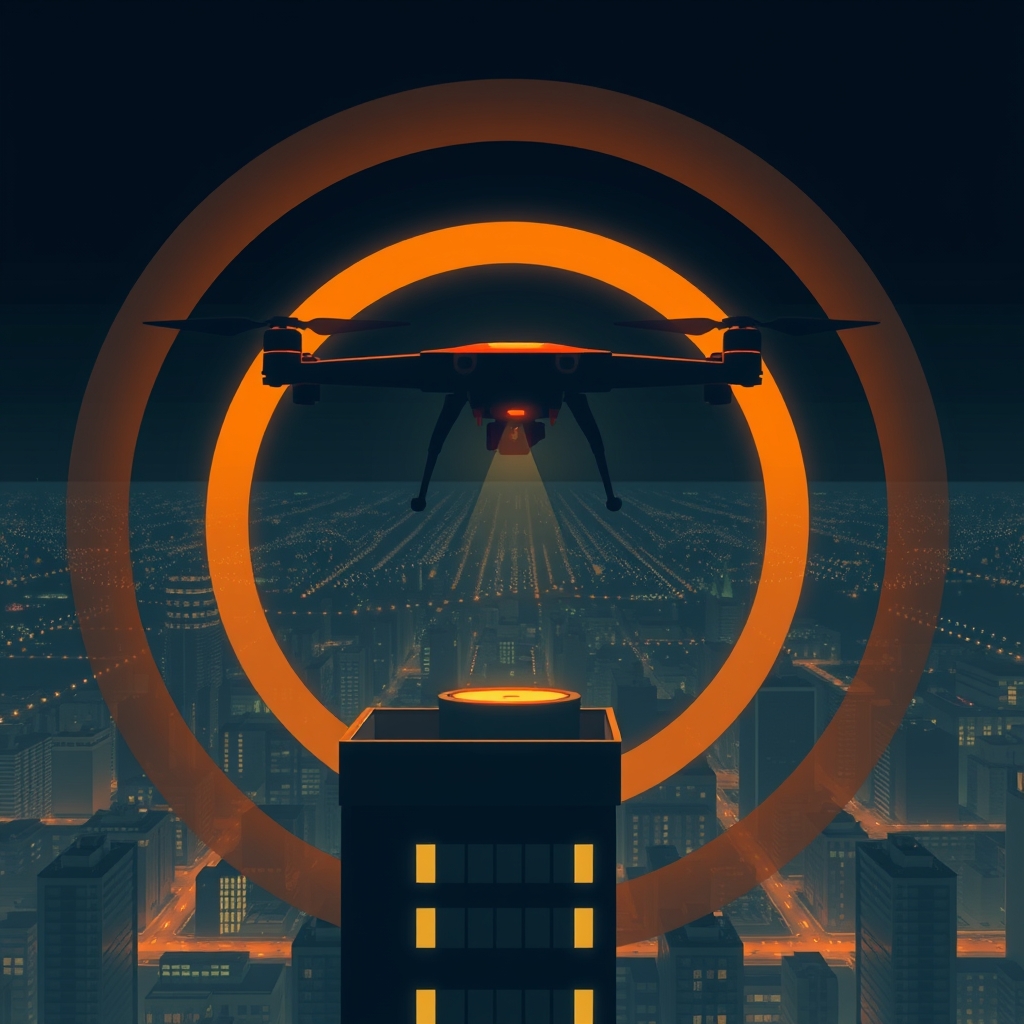
Plano is the eighth-largest city in Texas. Its police department will initially launch the DFR program using DJI Matrice aircraft, before transitioning to BRINC Guardian drones within 18 to 24 months. The program calls for two to four aircraft total, launched from rooftop docking stations installed atop city buildings, and operated by trained civilian staff in coordination with dispatchers — not sworn officers.
Police Chief Ed Drain presented the program's operational case to the council in terms of response time and situational awareness. Aerial units are projected to reach most Plano locations in approximately 2.5 minutes, roughly half the five-minute average for a patrol unit by ground. Drain outlined three primary mission categories: situational awareness, suspect identification, and officer safety. The drones will be equipped with imaging technology capable of identifying faces and license plates, and the program includes future plans for payload delivery — specifically medical countermeasures such as Narcan and EpiPen.
The decision to contract through Motorola Solutions, rather than directly with BRINC or DJI, is architecturally significant. Plano had already awarded Motorola a $5.7 million contract in June 2025 to replace aging portable radios and body-worn cameras, meaning the DFR program slots into an existing procurement relationship. Chief Drain described Motorola as the program's "aggregator" — the entity that owns the first-response dispatch software layer. The drones integrate into Motorola's CommandCentral Aware platform, where AI processes incoming 911 calls for keywords such as "heart attack" or "allergic reaction" to help dispatchers determine whether aerial deployment is appropriate. Officers in distress can also trigger drone dispatch directly via the emergency button on Motorola's APX NEXT smart radios.
The unanimity of the vote is notable. DFR approvals at the municipal level are often contested, with councils frequently divided over civil liberties and surveillance implications. Plano's 8-0 result suggests the program's operational framing — response time, officer safety, medical payload capability — was sufficiently persuasive to pre-empt the dissent that has characterized similar votes elsewhere.
Technical Breakdown
Phase 1 — DJI Matrice (Bridge Platform)
The initial aircraft are from DJI's Matrice series. The Matrice 4T, DJI's flagship public safety variant in the current generation, weighs under 1,230 g with battery and propellers, and delivers up to 49 minutes of flight time. Its integrated sensor suite includes a 640×512 thermal camera, a 48 MP telephoto camera with 112x hybrid zoom, and a laser rangefinder — a multi-sensor configuration optimized for search, suspect tracking, and scene assessment in both daylight and total darkness.
Phase 2 — BRINC Guardian (Target Platform, 18–24 Months)
- Platform class: Public safety DFR, rooftop-deployed
- Flight time: 62 minutes (manufacturer-specified)
- Top speed: Over 60 mph
- Range: Up to 8 miles — compared with approximately 3 miles for current non-Guardian DFR systems, a gap attributable to connectivity constraints that Starlink integration resolves
- Connectivity: World's first Starlink-connected drone in the DFR category, providing a reliable data link where terrestrial cellular or radio infrastructure is unavailable or congested
- Weather resistance: IP55
- Imaging: 4K video with 640x total zoom; dual HD thermal zoom cameras (1280-resolution, 64x total zoom) with optical HD thermal zoom — described by BRINC as a first for a drone of Guardian's size; integrated 1,000-lumen SkyBeam spotlight; built-in laser rangefinder
- Autonomy: High — the Guardian Station robotic docking nest autonomously swaps batteries and redeploys the aircraft to a new mission; it also auto-loads mission-appropriate payloads (defibrillators, flotation devices, Narcan, and others) without human intervention, enabling true 24/7 readiness
- Redeployment time: Battery swap and relaunch in under 40 seconds (per manufacturer)
- Software integration: BRINC drones integrate into Motorola's CommandCentral Aware (AI-assisted dispatch), APX NEXT smart radios, VESTA 911 call management software, Computer-Aided Dispatch systems, and Automatic License Plate Recognition technology
- Payload delivery: AEDs, Narcan, EpiPens, flotation devices (auto-loaded by Guardian Station based on incident type)
Industry Impact
For Manufacturers The Plano contract illustrates how the Motorola–BRINC exclusive distribution alliance is structurally changing the procurement pipeline for public safety drones in the United States. The initial DJI Matrice deployment serves as a functional bridge rather than a long-term platform — a pattern likely to repeat across agencies that are operationally ready to stand up DFR programs now but want to migrate to domestically manufactured hardware. BRINC has signed nearly four times as many 911 response drone contracts in the first half of 2026 as it had over the same period in 2025, with the Los Angeles Fire Department and St. Louis Police Department among recent customers. In July 2026, Motorola led a $125 million funding round for BRINC — bringing the company's total capital raised to well over a quarter billion dollars — with BRINC explicitly targeting the approximately 80,000 police and fire stations across the United States as its addressable deployment base.
For Operators The rooftop-docking, civilian-operated model that Plano is adopting removes the dependency on sworn-officer pilots, lowers per-deployment cost, and enables round-the-clock readiness once Guardian Station's autonomous battery-swap system is in place. The 2.5-minute projected response time — versus five minutes by ground unit — is the central operational argument, and the payload delivery capability extends the value proposition beyond surveillance into active medical response.
For Regulators Building-top launch sites for autonomous drone networks inside populated urban areas will require continued engagement with FAA frameworks governing Beyond Visual Line of Sight (BVLOS) and automated operations. Plano's program, like similar DFR deployments nationally, operates within a regulatory environment that is still evolving for fully autonomous, rooftop-launched systems at the city scale.
For Investors and Integrators Motorola Solutions' position as the exclusive North American DFR reseller for BRINC converts an existing government sales infrastructure — already present in the majority of American dispatch centers — into a drone distribution channel. For systems integrators, the depth of the software stack (CommandCentral, APX NEXT radios, CAD, ALPR) creates a tightly coupled ecosystem that rewards early alignment with the Motorola–BRINC architecture. BRINC's planned move into a manufacturing facility three times the size of its current factory before end of 2026 signals an expectation of significantly accelerating order volume.