
Singapore's Drone Mothership Fleet Grows: Keel Laid for Third Victory-Class MRCV
Singapore lays keel of its third MRCV drone mothership, as ST Engineering's six-ship programme accelerates toward 2028 delivery.
Main Story
Singapore's most consequential naval construction programme reached another structural milestone on September 3, 2026. ST Engineering announced the keel-laying of the third Victory-class Multi-Role Combat Vessel (MRCV) for the Republic of Singapore Navy (RSN) at ST Engineering Marine, with Singapore's Permanent Secretary (Defence), Joseph Leong, officiating the ceremony. RSN Chief Rear Admiral Sean Wat attended alongside representatives from the Defence Science and Technology Agency (DSTA) and ST Engineering Marine.
The milestone is significant for what it reveals about programme cadence. The keel-laying followed by just six weeks the July 23 launch of RSS Valour—the second MRCV—at ST Engineering's Benoi Shipyard. With the third hull now formally under construction, the programme simultaneously has vessels at different stages: one launched and fitting out, one freshly keeled, and two more for which steel was cut at a ceremony in April 2026. The RSN plans to receive the vessels progressively from 2028.
The construction tempo has visibly accelerated. For the lead ship, RSS Victory, steel was cut in March 2024, the keel was laid in October 2024, and the hull was launched in October 2025—a span of 592 days. For RSS Valour, the same sequence—steel cut April 2025, keel laid January 2026, launch July 2026—was completed in approximately 455 days. The narrowing interval points to a maturing production system at Benoi Yard.
The MRCV class retains the names and pennant numbers of the six Victory-class missile corvettes they replace. Those ships—Victory (88), Valour (89), Vigilance (90), Valiant (91), Vigour (92), and Vengeance (93)—entered service from 1989 and displace just 595 tonnes apiece. The new ships are more than thirteen times heavier.
The programme is a joint development led by DSTA, with DSO National Laboratories, ST Engineering, and international partners including Swedish firm Saab Kockums and Danish firm Odense Maritime Technology. Singapore's Ministry of Defence describes the vessel as combining the combat capabilities of a modern frigate with the carriage and control capacity of a mothership for unmanned systems across the air, surface, and underwater domains.
Technical Breakdown
Platform / Class: Victory-class Multi-Role Combat Vessel (MRCV); frigate-class surface combatant
Dimensions & Displacement: 150 m length, 21 m beam, 5.7 m draught, 8,000-tonne displacement—making it the largest and most complex warship built in Singapore to date.
Propulsion: Integrated Full Electric Propulsion (IFEP) combined with diesel propulsion; maximum speed in excess of 22 knots.
Range & Endurance: Operational range exceeding 7,000 nautical miles—twice that of the RSN's Formidable-class frigates—and endurance of more than 21 days.
Complement: Fewer than 100 personnel. Platform automation is cited as the basis for the reduced crew: the bridge can be operated by two crew instead of five, and the Engineering Control Centre by one crew instead of four.
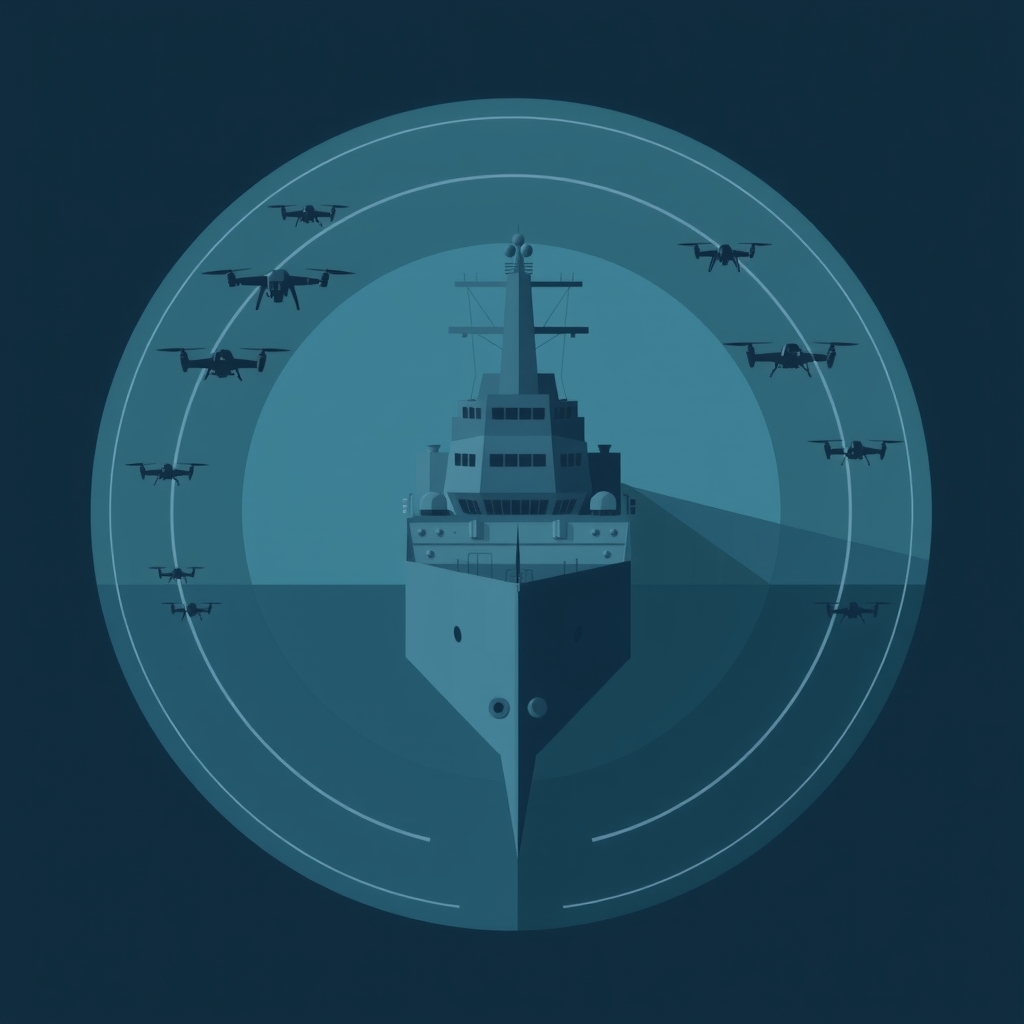
Unmanned Systems Integration (UAV/USV/UUV): This is the defining design characteristic. The MRCV is intended to deploy and recover aerial, surface, and underwater unmanned vehicles. A stern flight deck accommodates multiple UAVs or a single medium-lift helicopter. A launch and recovery system comprising a stern ramp and a side-mounted crane handles USVs and UUVs. A mission bay fitted with a cargo elevator can carry up to eight 20-foot containers, enabling rapid mission-role reconfiguration.
The aerial component has a domestically developed candidate already in RSN service. The Veloce 60 (V60) is a hybrid VTOL fixed-wing UAV co-developed by DSO National Laboratories and produced by ST Engineering. It carries a maximum take-off weight of up to 80 kg, a 5 m wingspan, a petrol engine for forward flight combined with electric lift rotors for vertical take-off and landing, a cruise speed of 50–70 knots, 12–14 hours of endurance, and a secure datalink range of up to 100 km. It is purpose-built for maritime ISR and can operate from naval decks in up to Sea State 5. The RSN has begun shipboard trials of the V60. MRCV renderings depict the V60 operating from the vessel's flight deck, though the final complement of UAV types has not been officially confirmed.
For subsurface operations, ST Engineering also produces the six-metre Mercury AUV, intended for seabed survey and mine countermeasures. The RSN is additionally progressing toward a new fleet of USVs and AUVs dedicated to mine countermeasure operations from 2027.
Weapons: The platform carries a Leonardo Strales 76 mm naval gun, two Rafael Typhoon MK 30-C remote-controlled weapon stations, MBDA Aster B1 NT long-range surface-to-air missiles, VL MICA NG short/medium-range missiles, and IAI Blue Spear anti-ship missiles.
Sensors: Sensor integration is expected to include a Thales multi-function AESA radar and Safran electro-optical systems. [Unconfirmed: specific designation of the Thales radar has not been officially confirmed by MINDEF or ST Engineering.]
Autonomy Level: High automation of ship systems reduces crew requirements significantly; unmanned systems are operator-controlled but designed for expanding levels of autonomous operation.
Industry Impact
For ST Engineering Marine: The accelerating build cadence—from 592 days for hull one to 455 days for hull two—validates the production system at Benoi Yard and demonstrates scalable throughput for a complex, multi-domain platform. Delivering six such vessels positions ST Engineering Marine among a small group of yards globally capable of constructing frigate-class drone motherships from domestic infrastructure.
For DSO National Laboratories and the domestic defence-tech ecosystem: The MRCV programme is functioning as an integration pipeline for indigenous unmanned systems. With the V60 already in RSN service and undergoing shipboard trials, and the Mercury AUV available for the mine-countermeasures role, Singapore is building a vertically integrated unmanned-systems supply chain—from airframe design at DSO to production and ship integration at ST Engineering—that bypasses dependence on foreign drone suppliers for core maritime ISR tasks.
For naval operators and peer navies: The Victory-class MRCV is among the first frigate-class hulls anywhere to be purpose-designed around multi-domain drone mothership duties rather than adapted to carry drones after the fact. The programme's stated design principle—that a single vessel can simultaneously conduct high-end combat, command-and-control, and unmanned-systems management—offers a template for other mid-sized navies evaluating how to integrate autonomous systems without acquiring separate dedicated mothership hulls.
For drone and unmanned-systems integrators: The mission bay's eight-container capacity and its dedicated crane and elevator infrastructure create a modular payload architecture. This design philosophy—swap containers to reconfigure between combat and humanitarian roles—signals demand for containerised drone launch-and-recovery solutions, containerised USV payloads, and standardised unmanned system interfaces suitable for shipboard deployment.
For investors and programme-watchers: With phased delivery from 2028 and six hulls on order, the programme represents a sustained, multi-year revenue stream for the ST Engineering Marine–DSTA–DSO consortium. The compressing build intervals suggest the programme is executing ahead of early projections, reducing schedule risk. The class is slated for commissioning through to around 2030, keeping the programme in active production for at least four more years.