
Weekly Digest — September 22, 2026
A pivotal week for autonomous platforms: Anduril's collaborative combat aircraft added a new mission dimension, a STOL UAS hit a battlefield first, an
A pivotal week for autonomous platforms: Anduril's collaborative combat aircraft added a new mission dimension, a STOL UAS hit a battlefield first, and cross-domain ISR architecture continued its rapid evolution.
Lead story
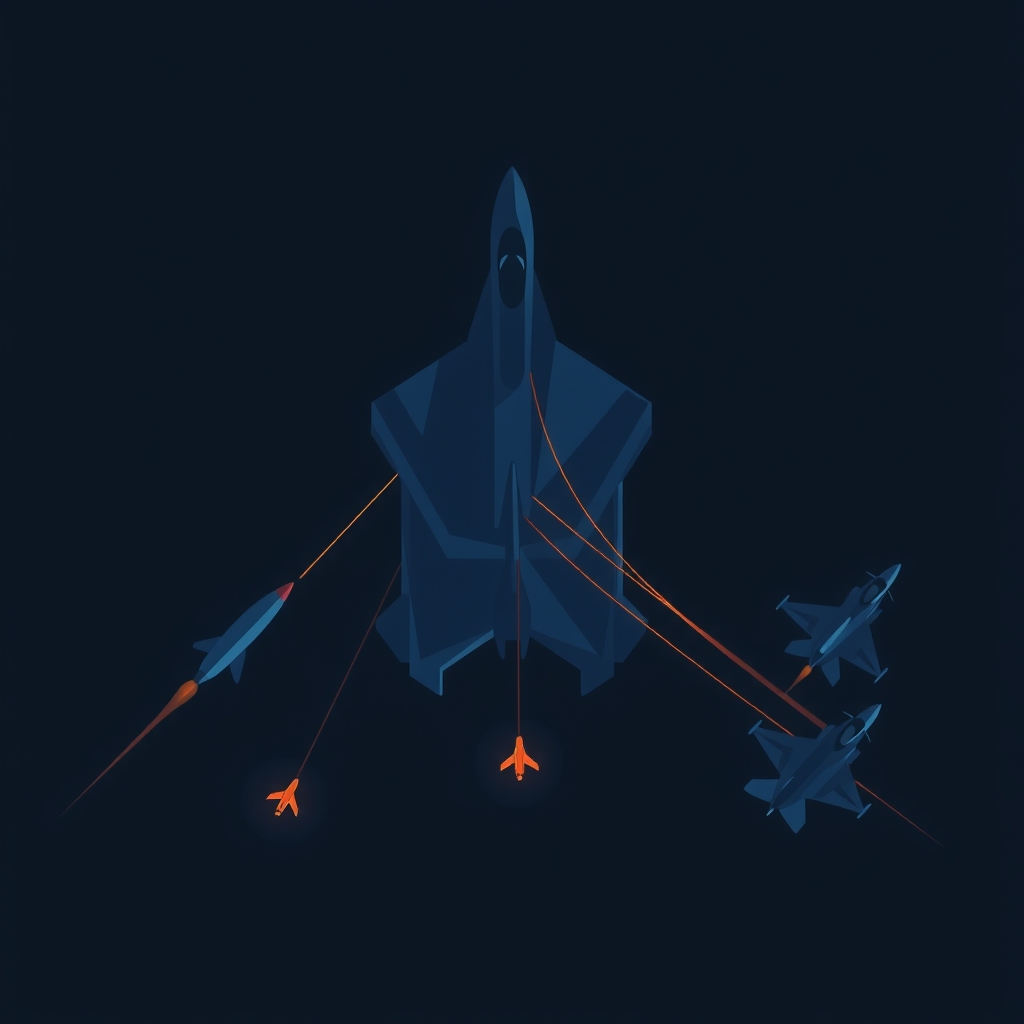
Anduril's YFQ-44A Fury Expands Its Weapons Options With Air-to-Ground Munitions — Anduril has completed ground-based fit checks of air-to-ground munitions on the YFQ-44A Fury CCA, formally broadening the platform's operational envelope beyond its originally stated air-to-air role. The company simultaneously confirmed the first formation flights between the Fury and U.S. Air Force F-35s — a key step in validating manned-unmanned teaming at the system level. Together, the two milestones materially accelerate the Fury's path toward multi-role operational status.
In focus
- Mojave STOL Drone Conducts First Battlefield Short-Field Operations in South Korea — GA-ASI's Mojave STOL completed the first MALE UAS landing and relaunch from a simulated battlefield surface — a rough maneuver trail in South Korea — marking a concrete step toward expeditionary basing without prepared runways. A Critical Design Review for the production Gray Eagle STOL variant is scheduled for November 2026.
- Drones, Satellites, and Common Controls: How Cross-Domain Connectivity Is Rebuilding ISR from the Ground Up — ISR architecture is being reengineered around unified control software and cross-domain data links that span drone fleets and space-based sensors, prioritising resilience in contested electromagnetic environments. The U.S. Air Force's Massed Modular Aircraft programme, Marine Corps common-controller initiatives, and Space Force ISR delta expansion are the primary programmatic expressions of this structural shift.
- High-Frequency Edge Sharpening Is All You Need: FPR Beats Transferable Adversarial Attacks With a Single Convolution — Researchers have demonstrated that a single channel-wise Laplacian sharpening convolution — requiring no surrogate model or iterative training — reduces transferable adversarial attack success rates by 12.7 percentage points and cuts targeted attack rates from 10.7% to 4.1%. The computational simplicity of Fast Preemptive Robustification makes it a practical candidate for hardening neural network inference pipelines deployed on edge platforms including UAS.
The rest of the week
- Marines Want Their Own Drone Boats: How a Combat Deployment Exposed the USMC's USV Gap
- AVI-SPL and Matternet Partner on Drone Delivery for Field Technicians
- NATO Jets Down a Drone Over Lithuania, Days After Chasing Birds
- Flytrex Adds Rooftop Drone Docks and AI Fleet Positioning in Dallas
- Auto-HSI: How LLMs Are Rewriting the Rules of Human-Swarm Control — On Demand
- NATO Rewrites Its Air Defence Playbook — For The First Time In Decades
- When 'Swarm' Doesn't Mean What Regulators Think: How the FCC's Drone Ban Could Ground America's Aerial Light Shows
- Swarm Aero Debuts Gamera: A Clean-Sheet, Non-Stealthy Group 5 UAS Built for Extreme Range and Mass Production
- BSC-Net: How a ResNet-U-Net Hybrid Is Solving the Small-Branch Problem in Coronary Artery Imaging